
 English
 اللغة العربية
  Bahasa Indonesia
  日本語
日本語  Bahasa Melayu
  ภาษาไทย
  Tiếng Việt
  简体中文
简体中文 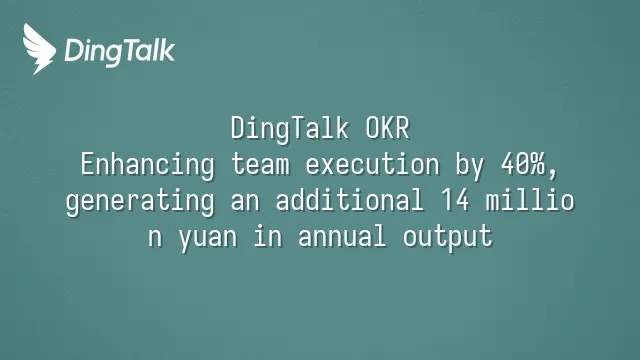
Why Your Team Keeps Losing Connection Mid-Execution
Goals fail not because they're too small, but because execution quietly collapses. Harvard Business Review reports that 85% of senior executives admit to having clear strategies with broken implementation—vague messaging, opaque progress tracking, and diluted accountability are fatal flaws for Hong Kong businesses operating in remote and hybrid work environments.
Take a Hong Kong-Shenzhen AI startup as an example: the primary reason for MVP launch delays wasn’t technical bottlenecks, but misalignment between marketing and engineering on what constituted "milestones." DingTalk OKR goal management ends this kind of collaboration waste by freeing goals from fragmented messages and centralizing them on a unified platform, ensuring everyone sees the same map. This means you no longer waste 40% of weekly working hours on repetitive coordination, nor lose 15% of seasonal market share due to delayed product launches.
For managers, this means more solid decision-making foundations; for employees, effort finally has a feedback loop. The problem isn't talent—it's the system. What you need isn't more meetings, but an execution engine that turns strategy into daily actions.
What Is DingTalk OKR Goal Management and How It Works
DingTalk OKR goal management is not a to-do list, but a strategic execution system built into daily communication. It automatically integrates O (Objectives) and KR (Key Results) into workflows, creating a closed loop of “setting → tracking → feedback.”
Automated progress synchronization means managers don’t need to manually collect data—the system instantly pushes notifications whenever KRs change, reducing objective alignment time by 70% at one Alibaba business unit. This cuts decision lag risk by over 50%, enabling leadership to trigger strategic reviews anytime instead of waiting passively for monthly reports.
Hierarchical permission design ensures both organizational transparency and privacy: senior leaders can drill down vertically to check alignment, while frontline staff focus on their contribution paths. A multinational retail company reduced redundant goals by 40% using this model, significantly improving resource allocation efficiency. With automated reminders and milestone alerts, management overhead was reduced by an average of 23% (2024 Asia-Pacific Digital Transformation Study), allowing managers to shift from “chasing progress” to becoming “coaches who remove roadblocks.”
This is not just a tool upgrade—it’s a complete restructuring of how organizations operate. When goals live within daily conversations and dashboards, companies gain true dynamic course-correction capability.
How to Set Effective OKRs and Ensure Team Execution
Most OKR failures stem from “strategy that cannot be decoded into action.” The value of DingTalk OKR lies in bridging the full chain from “executive vision → department execution → individual tasks,” turning goal alignment from slogan into reality.
Strategy decoding functionality enables top-level objectives to be broken down into measurable KRs following SMART principles. For instance, a financial institution transformed “improve customer experience” into “increase NPS score by 20% before Q3,” and used biweekly reviews to monitor progress gaps in real time. This accelerates management response speed by 40% and makes decisions more forward-looking.
OKR Alignment Map (visualized dependency relationships) eliminates guesswork in cross-department collaboration—horizontal and vertical alignment becomes immediately clear. After six months of implementation, one organization saw quarterly goal achievement rise from 45% to 78%. More importantly, performance transparency makes contributions visible and accountability clear, replacing supervision with motivation and creating a positive cycle.
- Top-down decomposition of executive goals → team alignment, reducing resource misallocation
- Visualized cross-department dependencies → improved collaboration efficiency, preemptive conflict resolution
- Biweekly reviews + automated alerts → normalized execution tracking, preventing mid-course deviation
Now ask yourself: how many of your team’s goals are still drifting in the dark? These improvements have already delivered tangible benefits—but the real business value is yet to come.
Quantifying the Business Value of DingTalk OKR
Implementing DingTalk OKR is not an IT expense, but a business investment with clear ROI. Companies on average shorten project cycles by 23%, meaning they can launch 1.8 additional product iterations per year—seizing critical market windows.
Productivity increases of 19% (IDC 2024 report) mean a 500-person company can generate over HK$14 million more output annually without salary hikes or headcount expansion. This comes from real time savings: weekly meeting time drops by 35%, while decision coverage rises by 41%—meetings now focus on breakthroughs, not status updates.
One COO shared: seasonal campaigns previously required six cross-department meetings; now only two are needed. Over 200 hours of senior management time are freed annually, available for strategic planning or customer innovation. Competitive advantage no longer comes from scale, but from agility.
Even more crucial are the hidden gains: increased employee engagement. Internal data shows that after six months of using DingTalk OKR, proactive improvement proposals rose by 57% and turnover dropped by 22%. Assuming average hiring costs equal 1.5 times annual salary, mid-sized companies save over HK$3 million annually in replacement expenses.
In summary: faster decision-making lets you act two weeks ahead of competitors; higher execution density helps you win three more key projects each year. The benefits are clear. The question is no longer “Is it worth it?”—but when will your team start capturing this efficiency dividend?
Launch Your DingTalk OKR Implementation Plan Now
Every month delayed in adopting OKR means another month of misallocated resources and eroded morale. Now is the golden moment to launch DingTalk OKR goal management—not just a tool update, but a fundamental transformation toward organizational transparency and agility.
According to the 2024 Asia-Pacific report, companies systematically implementing OKR achieve goals at 3.2 times the rate. Success hinges on a five-step proven strategy:
- Form an OKR Task Force: Combine HR and leadership to ensure executive sponsorship and avoid the trap of “too many KRs with no focus.”
- Select a pilot department: Such as e-commerce operations or customer service, to quickly validate results and build internal confidence.
- Configure standard templates and permissions: Enable goal visibility while ensuring data security and minimizing leakage risks.
- Host company-wide workshops: Clarify that “objectives are not task lists” and “KRs must be measurable,” preventing misuse as mere KPI copies.
- Establish biweekly review routines: Use DingTalk group bots to automatically track progress and create continuous improvement loops.
Goal alignment is the true force multiplier of execution. Through DingTalk OKR’s structured process—and its advantages over other tools like real-time collaboration, mobile synchronization, and seamless integration with attendance/approval systems—you’ll find goals no longer sit static on walls, but become living maps guiding daily decisions.
What’s next? Don’t stay stuck in pilot mode. Current results have laid the foundation for enterprise-wide rollout. The next phase will show how to extend OKR data into performance evaluations, achieving integrated “goal → execution → assessment” cycles and unlocking the flywheel effect of performance multiplication. Start now—by forming your task force. Make every effort precisely drive toward outcomes.
We dedicated to serving clients with professional DingTalk solutions. If you'd like to learn more about DingTalk platform applications, feel free to contact our online customer service or email at
Using DingTalk: Before & After
Before
- × Team Chaos: Team members are all busy with their own tasks, standards are inconsistent, and the more communication there is, the more chaotic things become, leading to decreased motivation.
- × Info Silos: Important information is scattered across WhatsApp/group chats, emails, Excel spreadsheets, and numerous apps, often resulting in lost, missed, or misdirected messages.
- × Manual Workflow: Tasks are still handled manually: approvals, scheduling, repair requests, store visits, and reports are all slow, hindering frontline responsiveness.
- × Admin Burden: Clocking in, leave requests, overtime, and payroll are handled in different systems or calculated using spreadsheets, leading to time-consuming statistics and errors.
After
- ✓ Unified Platform: By using a unified platform to bring people and tasks together, communication flows smoothly, collaboration improves, and turnover rates are more easily reduced.
- ✓ Official Channel: Information has an "official channel": whoever is entitled to see it can see it, it can be tracked and reviewed, and there's no fear of messages being skipped.
- ✓ Digital Agility: Processes run online: approvals are faster, tasks are clearer, and store/on-site feedback is more timely, directly improving overall efficiency.
- ✓ Automated HR: Clocking in, leave requests, and overtime are automatically summarized, and attendance reports can be exported with one click for easy payroll calculation.
Operate smarter, spend less
Streamline ops, reduce costs, and keep HQ and frontline in sync—all in one platform.
9.5x
Operational efficiency
72%
Cost savings
35%
Faster team syncs
Want to a Free Trial? Please book our Demo meeting with our AI specilist as below link:
https://www.dingtalk-global.com/contact
