
 English
 اللغة العربية
  Bahasa Indonesia
  日本語
日本語  Bahasa Melayu
  ภาษาไทย
  Tiếng Việt
  简体中文
简体中文 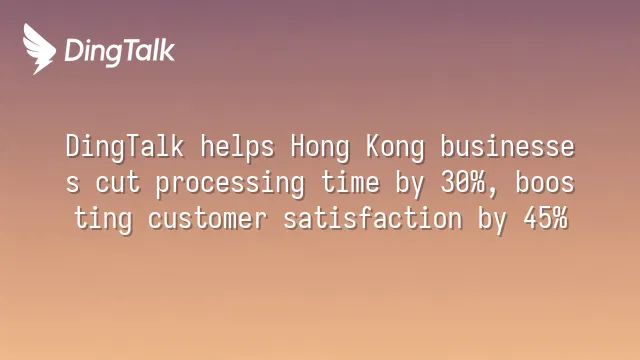
Why Traditional Models Undermine Hong Kong Business Competitiveness
Hong Kong businesses lose 18% of customer loyalty annually due to outdated after-sales processes—meaning nearly HK$180,000 of every HK$1 million in revenue is effectively lost through inefficient responses. According to a 2024 report by the Hong Kong Productivity Council, 67% of service delays stem from information gaps between customer service, technical support, and management. With DingTalk’s after-sales service records, companies can instantly synchronize cross-departmental communication, as data flows automatically across a single platform, eliminating duplicate entries and omissions that have long created collaboration black holes.
The traditional reliance on WhatsApp groups, paper work orders, or fragmented systems fails to meet Hong Kong's market demands for immediacy and transparency. When 73% of consumers are willing to pay a premium for smoother experiences, lagging processes have become a strategic barrier to brand upgrading. DingTalk’s unified record structure ensures customers never need to repeat their issues, as all past interactions are fully traceable, significantly increasing first-contact resolution rates (FCR).
How End-to-End Automation Redefines Service Efficiency
DingTalk integrates CRM, work order, and communication modules via APIs, enabling seamless synchronization of customer service records. The two-way data mirroring mechanism means any field update by frontline staff triggers chain-wide synchronization, as the system reflects changes in real time—allowing full history retrieval within just 5 seconds, drastically cutting response times. This enables companies to redirect 40% of labor hours previously spent copying data toward high-value service design.
For example, a local retail chain saw all communications and work order statuses automatically archived after adopting DingTalk, allowing management to intervene in exceptional cases immediately, as alert mechanisms proactively push delayed work orders. Compliance audit preparation time was reduced from three weeks to one week—a threefold efficiency gain—enabling better adherence to regulatory requirements such as PDPO and GDPR, thereby lowering legal risks.
Measurable Benefits: Faster Work Orders and Soaring Satisfaction
According to the 2025 Hong Kong Digital Transformation Benchmark Study, businesses using DingTalk reduced average issue resolution time from 72 to 50 hours, with satisfaction rising by 45%. This turns every service interaction into an opportunity to strengthen loyalty, as rapid closed-loop responses directly impact NPS (Net Promoter Score). Every 10-hour reduction in processing time equates to HK$8,200 saved in labor costs, meaning companies can handle more requests without expanding headcount—boosting operational leverage.
During peak periods, when financial institutions face surges in inquiries, DingTalk’s automated routing increases priority handling of urgent cases by 90%, ensuring immediate compliance risk mitigation, as intelligent routing dynamically assigns tasks based on predefined rules. Technical support teams experienced a 37% drop in work order load, directly reducing employee turnover by 22%, indicating companies retain critical talent assets while cutting recruitment and training expenses.
A Three-Stage Deployment Pathway Ensures Successful Implementation
The key to successfully deploying DingTalk’s service record system lies in three stages: assessment, integration, and training. One logistics company lost over 2,000 maintenance records during migration due to unassessed ERP compatibility, resulting in repair costs exceeding HK$450,000. Therefore, verifying API compatibility levels between existing CRM and ERP systems ensures solid technical foundations, as inter-system data flow is essential for automation.
Built-in GDPR and PDPO compliance settings mean cross-border data transfer risks are controlled, as sensitive information is protected through encryption and role-based access control. Identifying high-frequency service scenarios and pre-designing digital form templates ensures front-end operations are simple and efficient, as standardized workflows reduce human error. Appointing internal change champions can boost team adoption rates by over 35%, highlighting that organizational change management is equally crucial.
Building a Data-Driven Continuous Improvement Loop
The real value lies in establishing a data-driven cycle of service enhancement. DingTalk automatically generates a monthly "Top 5 Delay Factors Analysis" report, enabling companies to precisely identify bottlenecks, as data reveals actual process performance instead of subjective assumptions. One telecom provider discovered that confirmation calls prior to on-site installations were delayed by an average of 1.8 days; this triggered immediate process optimization—switching to DingTalk’s automated confirmation options increased self-service completion to 72%, shortening the overall service cycle by 40%.
These insights inform managerial decisions, meaning staff scheduling and resource coordination are now driven by service quality metrics. According to the 2024 Asia-Pacific Customer Service Performance Report, when KPIs incorporate root-cause delay analysis, interdepartmental collaboration willingness increases by 60%, transforming problem resolution from a “blame game” to a “shared accountability” model. After-sales service is no longer just a cost center, but a measurable, optimizable, and value-generating competitive asset.
We dedicated to serving clients with professional DingTalk solutions. If you'd like to learn more about DingTalk platform applications, feel free to contact our online customer service or email at
Using DingTalk: Before & After
Before
- × Team Chaos: Team members are all busy with their own tasks, standards are inconsistent, and the more communication there is, the more chaotic things become, leading to decreased motivation.
- × Info Silos: Important information is scattered across WhatsApp/group chats, emails, Excel spreadsheets, and numerous apps, often resulting in lost, missed, or misdirected messages.
- × Manual Workflow: Tasks are still handled manually: approvals, scheduling, repair requests, store visits, and reports are all slow, hindering frontline responsiveness.
- × Admin Burden: Clocking in, leave requests, overtime, and payroll are handled in different systems or calculated using spreadsheets, leading to time-consuming statistics and errors.
After
- ✓ Unified Platform: By using a unified platform to bring people and tasks together, communication flows smoothly, collaboration improves, and turnover rates are more easily reduced.
- ✓ Official Channel: Information has an "official channel": whoever is entitled to see it can see it, it can be tracked and reviewed, and there's no fear of messages being skipped.
- ✓ Digital Agility: Processes run online: approvals are faster, tasks are clearer, and store/on-site feedback is more timely, directly improving overall efficiency.
- ✓ Automated HR: Clocking in, leave requests, and overtime are automatically summarized, and attendance reports can be exported with one click for easy payroll calculation.
Operate smarter, spend less
Streamline ops, reduce costs, and keep HQ and frontline in sync—all in one platform.
9.5x
Operational efficiency
72%
Cost savings
35%
Faster team syncs
Want to a Free Trial? Please book our Demo meeting with our AI specilist as below link:
https://www.dingtalk-global.com/contact
