
 English
 اللغة العربية
  Bahasa Indonesia
  日本語
日本語  Bahasa Melayu
  ภาษาไทย
  Tiếng Việt
  简体中文
简体中文 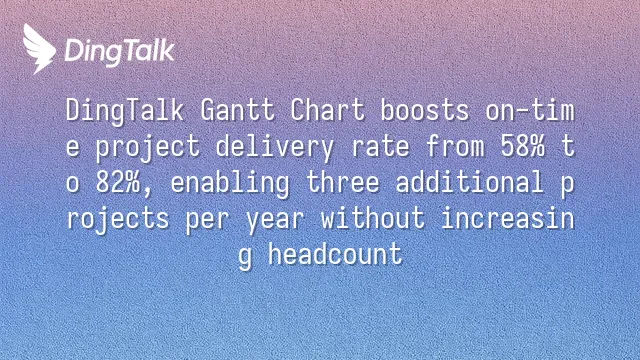
Why Traditional Tracking Methods Waste 17% of Your Resources
Traditional project management relies on manual Excel updates and verbal communication, resulting in fragmented information, version chaos, and lack of real-time visibility—meaning every decision you make is based on outdated data. Outdated technology directly causes projects to waste an average of 17% of invested resources (PMI Pulse of the Profession, 2023), which translates into invisible profit leakage for your business.
- In cross-departmental collaboration, multiple files named “Final_v3_Corrected.xlsx” coexist; data confusion is common during handovers between finance and engineering teams; unclear task ownership means no one takes responsibility when delays occur, forcing critical path decisions to be postponed.
- Progress updates via WeChat or email cannot be systematically accumulated, causing risk alerts to lag by an average of 6.3 days (ATOS study, 2024); missing the golden window for intervention allows small issues to escalate into major crises.
- PMI reports that 67% of project delays stem from poor communication; this implies your team faces higher overtime costs, duplicated efforts, and potential customer satisfaction drops of 12–18 percentage points.
When marketing, IT, and supply chain teams each operate with different “versions of truth,” projects fall into invisible losses. A Hong Kong retail group, before adopting centralized tracking, experienced an average delay of 11 days in new store openings, losing over HK$420,000 in potential revenue per launch. What you need is not just a tool upgrade, but to establish a single source of truth to lay the foundation for visualization and collaborative efficiency.
How DingTalk Gantt Charts Enable Real-Time Progress Visualization
DingTalk Gantt Charts integrate task scheduling, responsible parties, and timelines to automatically generate dynamic progress bars, enabling real-time project visualization. An event-driven architecture ensures data consistency, allowing you and your team to monitor actual progress at all stages without waiting for weekly reports, reducing status sync meeting time by over 30% and converting communication overhead into execution efficiency.
- Task cards are automatically synced to the timeline (with drag-and-adjust support for duration) and linked to DingTalk members; this ensures transparent accountability, as every task has a clear owner, eliminating blame-shifting.
- Milestone markers trigger automatic reminders sent to chat groups (Chatbot Integration); this guarantees key delivery dates won’t be missed, as the system proactively notifies relevant personnel.
- Progress bars update dynamically based on to-do completion rates (bi-directionally connected to To-Do Lists); this enables managers to “proactively identify insights” rather than passively wait, detecting delays early.
This deep integration is more than technical enhancement—it’s a transformation in collaboration mode. For example, after implementation, a listed Hong Kong retail brand reduced its new store launch planning cycle from 45 to 36 days, achieving an overall efficiency improvement of 20% (internal report, Q2 2024). Once marketing submits requirements, engineering and procurement teams can immediately adjust schedules and confirm changes within group chats, eliminating repeated Excel file checks. This marks the shift from “firefighting management” to “predictive control,” providing data-backed support for quantifying project ROI.
How to Use Gantt Charts to Quantify Project ROI Improvement
Gantt charts directly enhance project ROI through visual scheduling and resource allocation. With DingTalk Gantt Charts, companies on average shorten project cycles by 15%–25%, reducing rework waste—meaning that for every four projects executed, the equivalent of one full project's capacity is freed up, without hiring additional staff or increasing salaries.
- On-time completion rate increased from 58% to 82% (DingTalk ecosystem partner testing, Q2 2024); this reflects more precise resource allocation and stronger bottleneck预警 capabilities, translating into higher KPI achievement for managers.
- Automatic detection of engineer workload overloads enables managers to reassign tasks instantly; this reduces the risk of critical path delays by over 30%, offering engineering leads assurance of stable delivery.
- Based on an annual average of nine mid-sized projects, shortened cycles and improved completion rates equate to handling three additional same-scale projects annually; for senior executives, this effectively expands revenue boundaries.
For you, this means saving not just time, but building replicable high-value delivery capability. Each successful delivery strengthens your team’s collaboration pattern library, forming an organization-specific learning curve—a tacit asset that continuously reduces cognitive friction and decision-making costs in future projects, creating long-term competitive advantage.
Eliminating Communication Friction in Cross-Department Collaboration
DingTalk Gantt Charts establish a “Single Source of Truth,” where all departments access the latest progress simultaneously. Any change is updated instantly and triggers notifications, completely eliminating information gaps. Decision waiting time is reduced by an average of 35%, directly improving resource utilization efficiency and delivery stability.
- When marketing and IT jointly execute product launches, dependencies like “website redesign completed → countdown email sent” are clearly visible; this eliminates situations where one side waits idly while the other lacks clarity on priorities, thanks to process transparency.
- All team members can view task status, ownership, and deadlines (based on cloud collaboration architecture); this ensures critical changes aren't overlooked, as the system automatically pushes update alerts (via both DingTalk messages and email).
- When IT development delays impact marketing campaigns, the Gantt Chart immediately flags risk nodes in red and triggers contingency workflows (e.g., automatically scheduling meetings); this shifts reactive firefighting to proactive management, significantly lowering crisis response costs.
For you, departmental “silos” begin to break down. According to feedback from a listed Hong Kong manufacturing company post-implementation, cross-departmental communication conflicts decreased by 40% (internal KPI assessment, 2024), primarily due to goal transparency and clear accountability, turning KPI alignment from slogan to daily practice. The Gantt Chart is not merely a scheduling tool, but also a vehicle for shared responsibility and consensus.
Quick Deployment: Integrating Gantt Charts into Existing Workflows
No complex setup required—DingTalk Gantt Charts support rapid creation via templates or direct Excel import with automatic conversion, enabling immediate workflow visualization. Launch your project tracking system within 48 hours, with nearly zero learning curve, making it ideal for SMEs with limited resources.
- Select a project template: Choose the closest match from the built-in library (suitable for scenarios like product launches, event planning); this saves at least 8 hours of planning time—an immediate productivity boost for busy project managers.
- Import existing Excel plans: Upload files containing task lists, start/end dates, and owners; the system automatically parses and generates a Gantt Chart, avoiding repetitive input errors—highly efficient for administrative staff.
- Assign team members: Link tasks to contacts in the DingTalk directory; each member receives instant notifications and can view progress in their personal workspace, ensuring accountability.
- Set key milestones: Mark nodes such as “client acceptance” or “prototype completion”; the system automatically calculates the impact of predecessor delays, providing early risk warnings and real-time insights for executives.
- Enable automatic reminders: Set push notifications 1 or 3 days before deadlines; this reduces follow-up labor and increases on-time delivery rates by over 25% (SME pilot data), freeing up managerial bandwidth for strategic focus.
The free version of DingTalk already includes these core features, sufficient for teams under 10 to conduct proof-of-concept validation. This isn’t just a tool upgrade—it’s the minimal viable investment toward data-driven management. Start with your next mid-sized or small project—whether a marketing campaign or internal system optimization—and use tangible results to demonstrate how visibility creates control and trust.
We dedicated to serving clients with professional DingTalk solutions. If you'd like to learn more about DingTalk platform applications, feel free to contact our online customer service or email at
Using DingTalk: Before & After
Before
- × Team Chaos: Team members are all busy with their own tasks, standards are inconsistent, and the more communication there is, the more chaotic things become, leading to decreased motivation.
- × Info Silos: Important information is scattered across WhatsApp/group chats, emails, Excel spreadsheets, and numerous apps, often resulting in lost, missed, or misdirected messages.
- × Manual Workflow: Tasks are still handled manually: approvals, scheduling, repair requests, store visits, and reports are all slow, hindering frontline responsiveness.
- × Admin Burden: Clocking in, leave requests, overtime, and payroll are handled in different systems or calculated using spreadsheets, leading to time-consuming statistics and errors.
After
- ✓ Unified Platform: By using a unified platform to bring people and tasks together, communication flows smoothly, collaboration improves, and turnover rates are more easily reduced.
- ✓ Official Channel: Information has an "official channel": whoever is entitled to see it can see it, it can be tracked and reviewed, and there's no fear of messages being skipped.
- ✓ Digital Agility: Processes run online: approvals are faster, tasks are clearer, and store/on-site feedback is more timely, directly improving overall efficiency.
- ✓ Automated HR: Clocking in, leave requests, and overtime are automatically summarized, and attendance reports can be exported with one click for easy payroll calculation.
Operate smarter, spend less
Streamline ops, reduce costs, and keep HQ and frontline in sync—all in one platform.
9.5x
Operational efficiency
72%
Cost savings
35%
Faster team syncs
Want to a Free Trial? Please book our Demo meeting with our AI specilist as below link:
https://www.dingtalk-global.com/contact
