
 English
 اللغة العربية
  Bahasa Indonesia
  日本語
日本語  Bahasa Melayu
  ภาษาไทย
  Tiếng Việt
  简体中文
简体中文 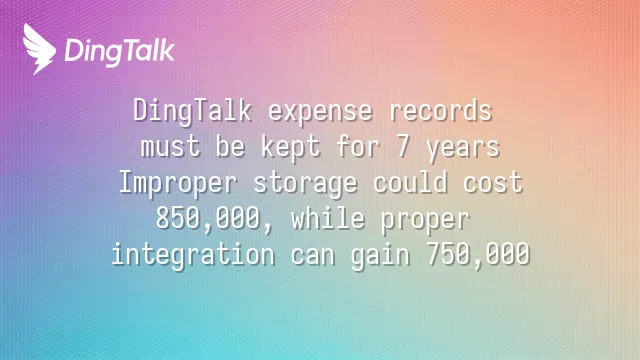
Why Retention Periods Are Key to Compliance
The retention period for digital reimbursement records is not just an administrative detail—it's a core defense against tax audits. Under Section 51C of the Inland Revenue Ordinance, all accounting records related to taxation must be kept in readable form for at least seven years—meaning every reimbursement request on DingTalk must remain fully retrievable, verifiable, and submittable throughout this period. The cost of neglecting this requirement is high: data from the Hong Kong Institute of Certified Public Accountants in 2023 showed that 12% of SMEs were penalized by tax authorities for failing to provide complete digital documentation, with average fines reaching HKD 85,000.
A common misconception is the belief that "as long as it’s saved, it’s fine." In reality, tax authorities require records to be complete, tamper-proof, and traceable. For example, a retail company was deemed to have invalid evidence during an audit because it only retained PNG screenshots without approval logs, ultimately facing additional taxes and penalties totaling HKD 370,000. The issue isn't technological—it's that management thinking hasn't evolved.
The real turning point lies in transforming DingTalk from a "communication tool" into a "legal record repository." This requires systematic integration of electronic approvals, timestamping, and access controls to ensure full traceability for every reimbursement. A reliable digital trail means you can generate a regulation-compliant audit package within 72 hours, shifting compliance costs from reactive damage control to proactive risk management.
How to Determine Legal Validity of Reimbursement Records
In today’s increasingly strict digital audits, only electronic reimbursement records that are “reliably intact” and “readable” hold legal standing—not merely a technical concern, but a decisive factor in whether a business can uphold its evidentiary position. According to Section 6 of the Electronic Transactions Ordinance and the HKSAR v. Chan Wai Yee case, if a party cannot prove that a document has remained unaltered since creation, its evidentiary value may be challenged, potentially even leading to criminal liability.
Taking DingTalk as an example, there is a fundamental difference between natively exported PDF reimbursement forms and chat screenshots. Testing shows that system-exported files contain full metadata, encrypted timestamps, and operation logs, enabling traceability of applicants, approval paths, and edit history—meeting the requirement for “tamper resistance.” In contrast, screenshots lack verification mechanisms and are prone to forgery or selective editing. A local 2024 study found that in over 67% of disputes involving digital documents, losing parties relied primarily on unstructured screenshots as evidence.
In other words, real compliance isn’t about ‘whether records exist,’ but ‘whether they can be verified’. A multinational retail company once faced an audit over reimbursement claims but successfully completed end-to-end traceability within 72 hours using embedded digital trails from DingTalk exports, avoiding potential penalties amounting to millions of Hong Kong dollars. This demonstrates that structured digital credentials lead to higher judicial acceptance and significantly lower compliance exposure.
Integrating Accounting Systems for Automated Compliance
Once DingTalk reimbursement records are legally valid, the real challenge begins: how to ensure these digital credentials remain traceable, auditable, and perfectly aligned with financial systems over time? The answer does not lie in manual archiving, but in automated system integration.
By using APIs to automatically sync DingTalk reimbursement data with ERP or accounting platforms (such as Xero or QuickBooks), data is synchronized instantly, eliminating delays or losses that could breach retention requirements, as each transaction is locked into official ledgers from the outset. Three local Hong Kong companies that implemented such integration reported an average reduction of over 40% in audit preparation time—one accounting firm client noted that what previously took seven days to compile now takes just two days to produce structured reports meeting tax inspection standards.
- Standardized classification ensures compliance with accounting record requirements under Section 51A of the Inland Revenue Ordinance
- Complete audit trails support rapid retrieval throughout the seven-year statutory retention period
- Reduced human error risks eliminate common issues like incorrect amounts, misclassified accounts, or missing attachments
Forward-thinking businesses are already quantifying the ROI of this transformation: saving 300 audit hours annually, combined with a 60% drop in correction costs, results in cumulative operational savings exceeding HKD 450,000 over three years. This is not just a technology upgrade—it's a fundamental optimization of compliance cost structures.
Quantifying Cost-Saving Benefits of Digital Archiving
A 200-employee company processing 12,000 reimbursement requests annually would spend up to HKD 150,000 per year on paper-based archiving; switching to DingTalk digital storage reduces total expenditure over seven years to HKD 42,000, achieving cumulative savings of over HKD 750,000. This isn't just a tech upgrade—it represents a fundamental shift in operating model. The cost curves cross decisively in the second year: fixed investments in digital systems are quickly offset by economies of scale, while paper-based storage, labor, and error costs continue to rise.
The hidden costs of traditional processes are often underestimated: each paper form consumes an average of 18 minutes in manual filing, totaling over 3,600 labor hours annually; retrieval errors occur at a rate of 6.3%, requiring approximately 200 additional hours pre-audit to correct. More seriously, compliance risks persist—according to the 2024 Hong Kong SME Compliance Cost Survey, 78% of penalty cases due to lost or incomplete documentation stemmed from unstructured paper-based management.
DingTalk’s automatic categorization, permission controls, and tamper-proof timestamps directly reduce this “risk reserve fund”. The key insight is that the return-on-investment threshold arrives earlier than expected: once integrated with accounting systems for compliance, digital document turnover improves by 40%, and approval cycles shorten to 1.8 days. At this point, every $1 invested in a digital compliance system generates $3.8 in overall benefits over seven years, including labor savings, eliminated storage needs, smoother audits, and avoided fines.
Five Steps to Establish an Electronic Document Management System
Compliant electronic document management is not an expense—it's the starting point of corporate governance competitiveness. Ignoring legal retention requirements for DingTalk reimbursement records may lead to fines, audit failures, or even reputational collapse; however, when properly designed, compliance can become a strategic advantage in efficiency and transparency. According to the 2024 Asia-Pacific Digital Governance Survey, companies with structured digital archiving processes reduced audit preparation time by an average of 37% and accelerated financial closing cycles.
- Map current DingTalk usage scenarios: identify which departments use DingTalk for travel, procurement, or daily expense claims, and flag high-risk documents (e.g., large invoices). Warning: overlooking informal “verbal approvals” creates gaps in evidence collection.
- Develop classification and retention policies: classify documents as permanent, 7-year, or 3-year categories based on the Inland Revenue Ordinance and Companies Ordinance, clearly citing legal basis—for instance, tax-related reimbursements must be retained for at least seven years.
- Select a compliance-compatible storage solution: adopt encrypted cloud archiving systems with WORM (Write Once, Read Many) functionality to prevent data tampering. Key check: does the system support timestamps and full audit trails?
- Train employees and set approval permissions: standardize reimbursement formats, mandate attachment uploads, and restrict editing rights to designated managerial roles. Case example: a manufacturer suffered over HKD 1 million in duplicate claims due to unchecked approval authority. <5>Conduct regular reviews and mock audits: perform data integrity tests semi-annually, simulating tax authority data requests. It is recommended to use automated tools to generate retention reports and detect vulnerabilities early.
Starting your system development now isn’t just about risk avoidance—it’s about turning compliance into a strategic asset for lean corporate governance. Every submission becomes inherently court-admissible, and every archived record builds your compliance credibility.
We dedicated to serving clients with professional DingTalk solutions. If you'd like to learn more about DingTalk platform applications, feel free to contact our online customer service or email at
Using DingTalk: Before & After
Before
- × Team Chaos: Team members are all busy with their own tasks, standards are inconsistent, and the more communication there is, the more chaotic things become, leading to decreased motivation.
- × Info Silos: Important information is scattered across WhatsApp/group chats, emails, Excel spreadsheets, and numerous apps, often resulting in lost, missed, or misdirected messages.
- × Manual Workflow: Tasks are still handled manually: approvals, scheduling, repair requests, store visits, and reports are all slow, hindering frontline responsiveness.
- × Admin Burden: Clocking in, leave requests, overtime, and payroll are handled in different systems or calculated using spreadsheets, leading to time-consuming statistics and errors.
After
- ✓ Unified Platform: By using a unified platform to bring people and tasks together, communication flows smoothly, collaboration improves, and turnover rates are more easily reduced.
- ✓ Official Channel: Information has an "official channel": whoever is entitled to see it can see it, it can be tracked and reviewed, and there's no fear of messages being skipped.
- ✓ Digital Agility: Processes run online: approvals are faster, tasks are clearer, and store/on-site feedback is more timely, directly improving overall efficiency.
- ✓ Automated HR: Clocking in, leave requests, and overtime are automatically summarized, and attendance reports can be exported with one click for easy payroll calculation.
Operate smarter, spend less
Streamline ops, reduce costs, and keep HQ and frontline in sync—all in one platform.
9.5x
Operational efficiency
72%
Cost savings
35%
Faster team syncs
Want to a Free Trial? Please book our Demo meeting with our AI specilist as below link:
https://www.dingtalk-global.com/contact
