
 English
 اللغة العربية
  Bahasa Indonesia
  日本語
日本語  Bahasa Melayu
  ภาษาไทย
  Tiếng Việt
  简体中文
简体中文 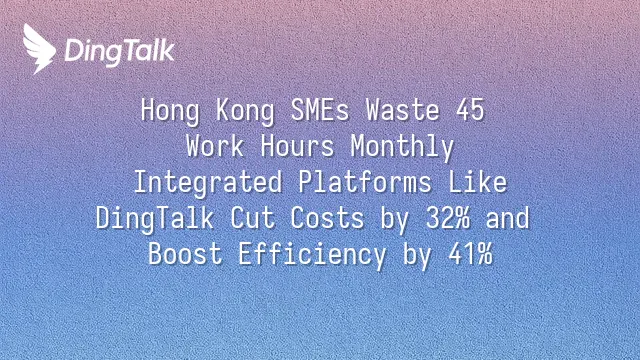
Why Hong Kong SMEs' Management Costs Keep Rising
The challenge facing Hong Kong SMEs isn't employee laziness, but fragmented systems—communication via WhatsApp, files stored on Google Drive, approvals done on paper. Information silos lead to delayed decisions and frequent errors. According to the 2025 Hong Kong SME Development Research Center survey, 68% of companies waste over 45 man-hours monthly on repetitive administrative tasks, equivalent to each office worker losing 12 working days annually.
Cross-department collaboration suffers from poor information synchronization, increasing error rates by 17%. Paper-based approvals take an average of 3.2 days to complete, causing cash flow bottlenecks. More seriously, managers cannot instantly access inventory, financial, or HR data, forcing them into constant firefighting mode. These hidden costs are eroding profits.
Dispersed communication tools mean delayed decisions, as critical information is scattered everywhere. A missed warehouse transfer instruction could trigger stock-out complaints; a delayed quotation approval might cost you the client to a competitor. The root problem: lack of a unified platform integrating "people, tasks, and processes."
The turning point lies in the "integrated operations hub" model—centralizing communication, documents, and business workflows. Data no longer sleeps on personal phones but becomes instantly traceable business assets. This is precisely where DingTalk breaks through.
How DingTalk Integrates Communication and Workflow in One Click
DingTalk’s real value lies in deeply integrating instant messaging, OA approvals, cloud storage, and attendance systems, replacing multiple isolated apps. This isn’t just feature stacking—it eliminates the gap between communication and operations. For example, the DingTalk Bot auto-reminder doesn’t just send notifications; it actively triggers actions based on workflow stages. If a quotation remains unprocessed after two hours, the bot reminds the supervisor; if still unresolved, it escalates to higher management.
Smart workflow reminders accelerate cash flow by reducing approval delays from 3 days to just 4 hours. After implementation, one local trading company shortened its order-to-payment cycle by 80%, with capital turnover speed increasing fivefold. The key? A visual workflow designer (no coding required), enabling HR or finance staff to build their own approval paths and track document status in real time.
Non-technical staff configuring workflows independently reduces IT dependency, cutting change deployment time from weeks to under one day. The 2024 Asia-Pacific SME Survey shows companies with this capability execute decisions 37% faster. This integration isn’t just convenient—it completely eliminates "waiting costs" from operations.
Real Results: Saving Over HK$1 Million in Cash Flow
According to the Hong Kong Institute of Certified Public Accountants’ 2024 report, SMEs that deployed DingTalk reduced administrative expenses by 32% and increased team productivity by 41%. For a company with HK$3 million annual operating costs, this frees up nearly HK$960,000 in annual cash flow—funds that can be reinvested in expansion or talent.
Take a chain retail brand: after using DingTalk's automated scheduling, store managers saved 15 hours weekly on manual coordination, reduced overtime by 27%, and cut annual labor compliance risk costs by HK$180,000. Another logistics firm replaced 200 daily paper delivery notes with electronic approvals, saving HK$80,000 annually on paperwork and storage, while document tracking time dropped from 4.2 days to instant.
Digitalized workflows reduce hidden costs because tasks become trackable and communications are recorded. One professional services firm found project delivery cycles shortened by 35%, while staff turnover dropped nearly 40%—indicating lower recruitment and training costs. These benefits show true savings come from transforming "time, manpower, and decisions" into measurable business returns.
A Four-Step, Zero-Failure Implementation Strategy
Whether an SME succeeds in adopting DingTalk depends on whether risks are managed in phases. Skipping planning and going straight live causes companies to waste an average of 200 man-hours in confusion during the first three months. In contrast, following the needs assessment → module selection → staff training → data feedback optimization four-step process shortens adaptation time by 50%, achieving 80% core process digitization within the first month.
Step one, "Needs Assessment", should involve both management and frontline staff identifying high-frequency repetitive tasks like expense claims or customer follow-ups. At the same time, activate features like Cantonese voice input and invoice scanning so employees immediately feel the convenience, reducing resistance. Step two, "Module Selection", should prioritize deploying "smart form-filling + approval workflows" to solve document-driven decision delays.
Step three, "Staff Training", works best with a "DingTalk Ambassador" program—one trained member per department helps colleagues adopt the system. After a logistics company implemented this, system usage jumped from 43% to 89% within a month. Finally, step four, "Data Feedback Optimization", requires setting clear KPIs—such as number of days saved in approval cycles—and reviewing backend activity reports every two weeks to dynamically adjust workflows.
Upgrading to a Predictive Intelligent Management Ecosystem
DingTalk is more than a tool—it’s the strategic foundation for shifting from "firefighting management" to "predictive operations." With AI-powered meeting summary generation, information compilation that once took hours is now completed in minutes. More importantly, its open API connects accounting software and CRM systems, consolidating fragmented data into dynamic dashboards.
AI summaries turn meeting outcomes into immediate action, automatically generating and assigning tasks from key points. One retail brand used data analytics to discover a 27% sales increase every March, yet staffing levels remained unchanged, leading to declining service quality. After the system issued a warning, they hired part-time staff in advance, boosting customer satisfaction by 19% and reducing labor waste by 14%.
Open API integration enables more forward-looking decisions, making financial, sales, and HR data instantly visible. Managers gain precise visibility into cash flow, inventory, and team workloads, allowing proactive resource allocation. Real competitive advantage doesn’t come from how many tools you have, but from building a continuously evolving intelligent ecosystem. Now, with just one free performance diagnostic, you can identify bottlenecks and begin your journey toward predictive management.
We dedicated to serving clients with professional DingTalk solutions. If you'd like to learn more about DingTalk platform applications, feel free to contact our online customer service or email at
Using DingTalk: Before & After
Before
- × Team Chaos: Team members are all busy with their own tasks, standards are inconsistent, and the more communication there is, the more chaotic things become, leading to decreased motivation.
- × Info Silos: Important information is scattered across WhatsApp/group chats, emails, Excel spreadsheets, and numerous apps, often resulting in lost, missed, or misdirected messages.
- × Manual Workflow: Tasks are still handled manually: approvals, scheduling, repair requests, store visits, and reports are all slow, hindering frontline responsiveness.
- × Admin Burden: Clocking in, leave requests, overtime, and payroll are handled in different systems or calculated using spreadsheets, leading to time-consuming statistics and errors.
After
- ✓ Unified Platform: By using a unified platform to bring people and tasks together, communication flows smoothly, collaboration improves, and turnover rates are more easily reduced.
- ✓ Official Channel: Information has an "official channel": whoever is entitled to see it can see it, it can be tracked and reviewed, and there's no fear of messages being skipped.
- ✓ Digital Agility: Processes run online: approvals are faster, tasks are clearer, and store/on-site feedback is more timely, directly improving overall efficiency.
- ✓ Automated HR: Clocking in, leave requests, and overtime are automatically summarized, and attendance reports can be exported with one click for easy payroll calculation.
Operate smarter, spend less
Streamline ops, reduce costs, and keep HQ and frontline in sync—all in one platform.
9.5x
Operational efficiency
72%
Cost savings
35%
Faster team syncs
Want to a Free Trial? Please book our Demo meeting with our AI specilist as below link:
https://www.dingtalk-global.com/contact
