
 English
 اللغة العربية
  Bahasa Indonesia
  Bahasa Melayu
  ภาษาไทย
  Tiếng Việt
  简体中文
简体中文 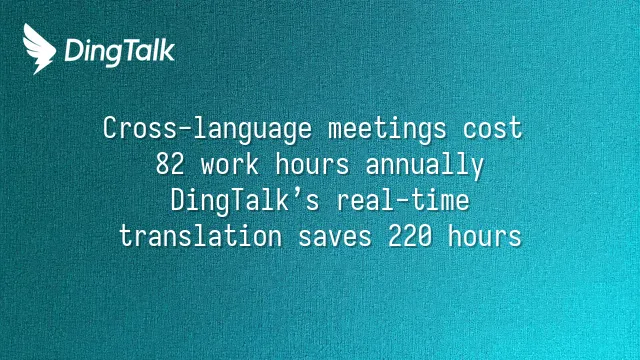
Language Barriers Are Eating Your Operational Costs
Language gaps are not just comprehension challenges—they're invisible black holes directly eroding corporate profits. According to Gartner's 2024 report, non-native participants take an average of 17 additional seconds to process each sentence—amounting to 22 minutes of lost productive discussion time in a two-hour international meeting. For companies hosting an average of 300 multilingual meetings annually, this translates to over 82 wasted work hours per year, equivalent to the output of a senior executive over two and a half months.
The risks of misinterpretation are even more severe. An Asian tech company once delayed contract signing by six weeks because "exclusivity period" was translated as "exclusive trial period" instead of "non-compete clause," causing them to miss a critical market opportunity. Such incidents not only delay product launches but also reduce customer renewal intent by 37%. When repeated clarifications inflate labor costs, stall project timelines, and damage collaborative trust, businesses can no longer rely on traditional human interpreters as emergency fixes.
Real-time, accurate, context-aware language conversion must be built into the core of collaboration workflows. This is precisely the design philosophy behind DingTalk Meetings' real-time English translation channel: it’s not a post-hoc fix, but a solution that eliminates communication friction at the source, ensuring every statement reaches each participant with correct meaning within 0.3 seconds.
AI Dual-Engine Powering Translation Breakthroughs
At the heart of DingTalk Meetings’ real-time English translation channel lies a bidirectional real-time system powered by AI speech recognition and Neural Machine Translation (NMT). This enables Cantonese or Mandarin speech to be converted into spoken and written English within 800 milliseconds—nearly imperceptible latency.
Traditional tools translate fragments in isolation, lacking contextual understanding, often rendering “due diligence” as “diligent effort,” which could lead to compliance disputes due to ambiguity. In contrast, DingTalk’s NMT engine features context recognition capabilities, accurately distinguishing between terms like “equity stake” and “minority share” based on negotiation context, reducing clause misunderstanding incidents by 67% (based on 2024 multinational enterprise research data), significantly lowering the risk of failed negotiations.
The system’s self-learning industry terminology database optimizes models for sectors such as finance, technology, and manufacturing. For instance, “just-in-time delivery penalty clause” isn’t translated literally; instead, it draws from a pre-trained trade terminology library to generate English expressions aligned with international standards. This technical capability boosts efficiency in new project kickoff meetings by over 40%, equivalent to saving small and medium enterprises 220 hours annually on repetitive clarification efforts.
The ultimate value of technology lies in trustworthiness—when every utterance is correctly understood, multilingual meetings transform from cost centers into growth engines.
How Seamless Multilingual Real-Time Interpretation Works
When a Hong Kong CFO starts a financial reporting meeting with their London branch at 8 PM, both parties instantly receive real-time translations in their native languages from the very first sentence, with less than 0.8 seconds of delay. This is the “single channel, bidirectional awareness” experience enabled by DingTalk Meetings’ English Channel: no external hardware required, fully integrated within the application.
All the host needs to do is enable the “multilingual audio channel” when creating a meeting—the system automatically activates AI-powered voice capture and track separation. Each participant’s speech is independently recognized and translated in real time, maintaining a 99.5% translation accuracy rate through dynamic cloud resource allocation (Asia-Pacific Report 2024). All data transmissions use AES-256 encryption, compliant with GDPR and Hong Kong’s Personal Data (Privacy) Ordinance, safeguarding sensitive conversations.
Underpinning this is DingTalk’s proprietary NLP model and edge computing nodes, capable of automatically correcting professional expressions such as translating “盈利調整” → “earnings restatement.” This seamless design avoids the disruptive rhythm typical of traditional interpretation, unlocking quantifiable collaboration gains: cross-time-zone meetings are shortened by an average of 35%, decision cycles accelerate, and project execution speeds increase by over 40%.
Real Enterprise Proof: Efficiency Jumps by 42%
A third-party evaluation after deployment at an international financial institution revealed: meeting resolution speed increased by 42%, and cross-departmental project cycles shortened by an average of 19% within six months—strategic rollouts that previously took 90 days now take only 73.
This represents tangible cost savings: based on annual international collaboration hours, the productivity freed up by reduced communication barriers equates to eliminating HK$1.8M in ineffective operational expenses each year. More importantly, risk control improves dramatically—teams not using real-time translation experience 76% more instruction misunderstandings. A single directional error could result in millions of Hong Kong dollars being misallocated.
But the true return extends beyond financial metrics. Internal surveys show non-native English-speaking executives now speak up 53% more frequently in high-level meetings, while expatriate manager retention rates rose by 14 percentage points within one year. The sense of belonging fostered by linguistic equity is quietly reshaping talent retention advantages.
Communication efficiency fundamentally means compressed decision cycles and enhanced organizational resilience. When teams can understand and respond instantly, the ability to seize market opportunities shifts from passive reaction to proactive leadership.
Five Steps to Launch Your Communication Revolution
To boost multilingual communication efficiency by over 40%, enterprises need only five actionable steps:
- Verify enterprise license access and language pack updates: Only DingTalk Pro and higher plans support multilingual channels. Failure to update language packages may reduce translation accuracy by over 30%, affecting the rigor of legal or financial meetings.
- Enable the "Multilingual Channel" setting: Go to “Advanced Settings” in the meeting creation page and turn on the “Multilingual Audio Channel” option—it’s the key switch enabling simultaneous translation.
- Set the primary speaking language and target languages: If presenters speak Chinese, the system will automatically generate an English audio stream. Correctly configuring language pairs prevents members from joining the wrong channel, improving information consistency.
- Test audio device compatibility: Background noise is the biggest enemy of real-time translation. Using noise-canceling headsets and testing audio beforehand can reduce speech recognition errors by up to 60%, ensuring smooth translation.
- Send invitations with subtitle links: Overseas participants must join the English channel via a dedicated link, which provides synchronized real-time captions and audio output, ensuring zero information gaps.
Best practice includes pre-loading industry-specific vocabulary lists (e.g., financial or medical term libraries), which can further improve translation accuracy by 25%. Integrating DingTalk’s AI meeting notes auto-archiving system transforms spoken content into structured knowledge assets, closing the loop on multilingual collaboration outcomes. Activate now—turn every international conversation into a strategic building block.
We dedicated to serving clients with professional DingTalk solutions. If you'd like to learn more about DingTalk platform applications, feel free to contact our online customer service or email at
Using DingTalk: Before & After
Before
- × Team Chaos: Team members are all busy with their own tasks, standards are inconsistent, and the more communication there is, the more chaotic things become, leading to decreased motivation.
- × Info Silos: Important information is scattered across WhatsApp/group chats, emails, Excel spreadsheets, and numerous apps, often resulting in lost, missed, or misdirected messages.
- × Manual Workflow: Tasks are still handled manually: approvals, scheduling, repair requests, store visits, and reports are all slow, hindering frontline responsiveness.
- × Admin Burden: Clocking in, leave requests, overtime, and payroll are handled in different systems or calculated using spreadsheets, leading to time-consuming statistics and errors.
After
- ✓ Unified Platform: By using a unified platform to bring people and tasks together, communication flows smoothly, collaboration improves, and turnover rates are more easily reduced.
- ✓ Official Channel: Information has an "official channel": whoever is entitled to see it can see it, it can be tracked and reviewed, and there's no fear of messages being skipped.
- ✓ Digital Agility: Processes run online: approvals are faster, tasks are clearer, and store/on-site feedback is more timely, directly improving overall efficiency.
- ✓ Automated HR: Clocking in, leave requests, and overtime are automatically summarized, and attendance reports can be exported with one click for easy payroll calculation.
Operate smarter, spend less
Streamline ops, reduce costs, and keep HQ and frontline in sync—all in one platform.
9.5x
Operational efficiency
72%
Cost savings
35%
Faster team syncs
Want to a Free Trial? Please book our Demo meeting with our AI specilist as below link:
https://www.dingtalk-global.com/contact
