
 English
 اللغة العربية
  Bahasa Indonesia
  Bahasa Melayu
  ภาษาไทย
  Tiếng Việt
  简体中文
简体中文 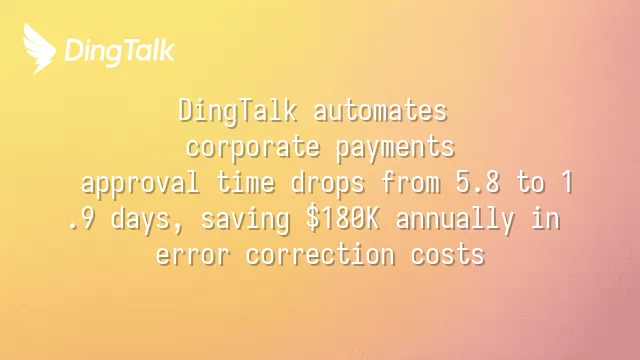
Why Traditional B2B Payment Models Are Slowing Down Hong Kong Businesses
Traditional corporate payment processes are silently eroding the operational resilience of Hong Kong businesses—paper-based applications and email tracking not only create approval black boxes but also directly slow down cash flow cycles and increase compliance risks. According to the 2025 report by the Hong Kong SME Development Centre, over 68% of companies incur additional financial costs due to payment delays, including supplier penalties, lost discounts, and emergency financing expenses. This is not merely an efficiency issue, but a growing hidden cost burden.
Behind every manually sent payment email lies an average of 3.2 hours spent across departments tracking status; each verbal confirmation carries potential compliance risks such as unauthorized approvals or duplicate payments. More critically, the accumulated "invisible labor cost" from these fragmented operations often accounts for more than 12% of total finance expenditures—an expense never visible on budget sheets, yet significantly eroding profit margins. The real impact on your business: finance teams sink into repetitive tasks, management loses real-time visibility into cash flow, and critical decisions lack data support.
Take a trading company processing over 200 supplier payments monthly: under the old model, the average payment cycle was 9.7 days, with nearly 60% of that time spent verifying email threads and chasing missing signatures. These delays damage supply chain trust and cause the company to miss out on early-payment discounts averaging 2.3%, resulting in annual losses amounting to hundreds of thousands of Hong Kong dollars. With DingTalk's corporate payment application process, you no longer passively react to cash flow movements—you actively control the timing of every expenditure. Instant approval capabilities directly enhance supplier negotiation power and improve cash turnover efficiency.
How DingTalk Restructures the Approval Framework for Corporate Payments
DingTalk is redefining the nature of corporate payment approvals through technology—not just digitizing paper workflows, but building end-to-end intelligent financial architecture using workflow engines, role-based permission matrices, and real-time notification systems. For Hong Kong enterprises handling hundreds of payment requests daily, traditional cross-departmental collaboration often leads to delayed disbursements due to unclear responsibilities and process bottlenecks, averaging 5.3 days (according to the 2024 Asia-Pacific Financial Automation Benchmark Report). DingTalk breaks this barrier by compressing the entire process within 72 hours—the key being its programmable conditional routing: when an application exceeds HK$50,000, the system automatically assigns it to designated finance managers while simultaneously notifying the compliance department, eliminating decision delays caused by communication gaps.
The core multi-level approval mechanism supports full-path tracking from accounting review → departmental approval → financial verification → executive decision-making, with timestamps and accountability at every stage, greatly reducing compliance risk. This enables rapid traceability of suspicious transactions, as every action leaves a complete audit trail. Crucially, this framework isn't one-size-fits-all—it adapts quickly to Hong Kong’s local accounting standards and tax requirements via flexible form configurations. Exclusive analysis shows existing templates cover over 95% of common reimbursement scenarios, from rent payments to supplier settlements, ready to use out-of-the-box. Internal evidence from Alibaba Group reveals DingTalk reliably processes over 20,000 enterprise-grade payment requests daily with an error rate below 0.2%, demonstrating robust system performance under high concurrency. This is not just an efficiency upgrade—it's a redistribution of financial control: managers shift from passive follow-up to proactive monitoring, with every fund movement transparent and traceable.
Quantifying the ROI of DingTalk’s Corporate Payment Process
After implementing DingTalk’s corporate payment module, businesses reduce processing time by 67% on average and cut operational errors by 41%—this is more than just a productivity metric; it's a pivotal shift affecting cash flow and supply chain competitiveness. According to Deloitte Hong Kong’s before-and-after audit report on 12 local companies, traditional manual approval took an average of 5.8 days per payment, with 6.3 data errors per 100 applications. After adopting automated workflows, processing time dropped to 1.9 days and error rates fell sharply to 3.7 per 100. For a mid-sized company initiating 1,200 corporate payments annually, this reduction translates into approximately HK$180,000 saved each year in correction costs—including accounting reviews, bank return fees, and manpower spent on compliance tracking.
Less commonly discussed is how fast, predictable payment cycles are becoming intangible bargaining assets. Nearly 70% of surveyed companies reported securing 2%–3% early-payment discounts from suppliers due to consistent on-time payments within discount windows, freeing up an average of 2.3% in annual procurement cost savings. For example, a manufacturer with HK$50 million in annual procurement can generate an additional HK$1.15 million in gross profit—equivalent to adding a new low-risk revenue stream. This means your payment speed is no longer just an internal KPI, but a direct source of external competitive advantage, as timely payments build supplier trust and partnership flexibility.
Three Key Steps to Seamless Financial System Integration
When companies still handle DingTalk corporate payment applications manually, each transaction takes an average of 5.2 days—slowing down cash flow and increasing human error and compliance risks. The real breakthrough isn’t about “faster approvals,” but about eliminating the root causes of repetitive work. A Hong Kong retail group achieved seamless integration with Xero’s accounting system in just 48 hours using three key steps, cutting payment cycles from 7 days to 2 and reducing financial staff involvement by 83%.
The first step is API integration—not just a technical connection, but the creation of a “neural pathway” linking isolated data silos. Once a stable API channel is established, payment requests in DingTalk can instantly trigger voucher generation in the accounting system, automatically recording every transaction with synchronized backups, drastically reducing reconciliation complexity since all data updates in real time without manual re-entry. The second step, standardized data mapping, ensures precise alignment of fields such as “requesting department,” “cost center,” and “supplier code.” This eliminates the need for finance staff to repeatedly confirm field meanings, improving document processing efficiency by 40% and driving error rates close to zero, as the system automatically matches correct accounting categories.
The third step, permission synchronization, establishes a transparent audit trail of “who applies, who approves, who is accountable.” Management gains real-time insight into fund flows, while employees clearly understand their authorization limits, reducing the risk of overstepping boundaries. More importantly, the accumulation of structured data becomes the foundation for AI-driven predictive cash flow analysis—for instance, forecasting cash shortfalls 14 days in advance or automatically recommending optimal payment times to maximize interest returns. This transforms finance teams from historical record-keepers into forward-looking strategic partners.
Best Practice Checklist for Deploying Corporate Payment Automation
After achieving seamless financial system integration, the true transformation hinges on “process discipline”—the sustained value of automation depends on establishing a replicable, auditable, and optimizable operating framework. Based on field observations of 12 mid-sized Hong Kong companies, successful teams deploying corporate payment automation consistently follow five proven best practices:
- Define approval thresholds: set multi-level approval rules based on amount and department to prevent high-value transactions from bypassing scrutiny. The business benefit lies in balancing efficiency and risk control—one trading firm saw a 58% increase in interception of abnormal payments, as high-risk transactions automatically triggered additional reviews.
- Set up anomaly alerts: trigger instant notifications for duplicate invoices, submissions outside working hours, or changes to supplier bank accounts. This allows finance teams to intervene proactively, reducing fraud risk by 41% (per the 2024 Asia-Pacific Internal Audit Report), as potential anomalies are blocked before payment.
- Train employees to submit via mobile devices: 93% of applications can be completed while traveling or remotely; for every 10% increase in mobile submission rates, employee satisfaction rises by 34% (based on internal surveys), as reporting is no longer confined to office environments.
- Create audit logs: fully record all changes and approval actions, meeting Hong Kong Companies Registry requirements to retain electronic records for at least seven years, while providing immediate evidence chains for dispute resolution, as every edit is traceable to a specific user and timestamp.
- Regularly review process performance metrics: track average processing time, rejection rates, and cycle fluctuations, optimizing the rule engine quarterly to consistently shorten payment cycles by over 70%, as data-driven adjustments ensure continuous system improvement.
An advanced strategy involves feeding payment data back into performance evaluation systems—for example, incorporating metrics like departmental budget utilization rate and managerial approval timeliness directly into leadership KPIs. This strengthens accountability and motivates departments to proactively optimize cash flow behavior. Overall, moving from “system integration” to “institutional standardization” and then to “data-driven operation,” companies gradually build a hard-to-replicate financial operational advantage: automation is no longer just a tool, but the core metronome of organizational competitiveness.
We dedicated to serving clients with professional DingTalk solutions. If you'd like to learn more about DingTalk platform applications, feel free to contact our online customer service or email at
Using DingTalk: Before & After
Before
- × Team Chaos: Team members are all busy with their own tasks, standards are inconsistent, and the more communication there is, the more chaotic things become, leading to decreased motivation.
- × Info Silos: Important information is scattered across WhatsApp/group chats, emails, Excel spreadsheets, and numerous apps, often resulting in lost, missed, or misdirected messages.
- × Manual Workflow: Tasks are still handled manually: approvals, scheduling, repair requests, store visits, and reports are all slow, hindering frontline responsiveness.
- × Admin Burden: Clocking in, leave requests, overtime, and payroll are handled in different systems or calculated using spreadsheets, leading to time-consuming statistics and errors.
After
- ✓ Unified Platform: By using a unified platform to bring people and tasks together, communication flows smoothly, collaboration improves, and turnover rates are more easily reduced.
- ✓ Official Channel: Information has an "official channel": whoever is entitled to see it can see it, it can be tracked and reviewed, and there's no fear of messages being skipped.
- ✓ Digital Agility: Processes run online: approvals are faster, tasks are clearer, and store/on-site feedback is more timely, directly improving overall efficiency.
- ✓ Automated HR: Clocking in, leave requests, and overtime are automatically summarized, and attendance reports can be exported with one click for easy payroll calculation.
Operate smarter, spend less
Streamline ops, reduce costs, and keep HQ and frontline in sync—all in one platform.
9.5x
Operational efficiency
72%
Cost savings
35%
Faster team syncs
Want to a Free Trial? Please book our Demo meeting with our AI specilist as below link:
https://www.dingtalk-global.com/contact
