
 English
 اللغة العربية
  Bahasa Indonesia
  日本語
日本語  Bahasa Melayu
  ภาษาไทย
  Tiếng Việt
  简体中文
简体中文 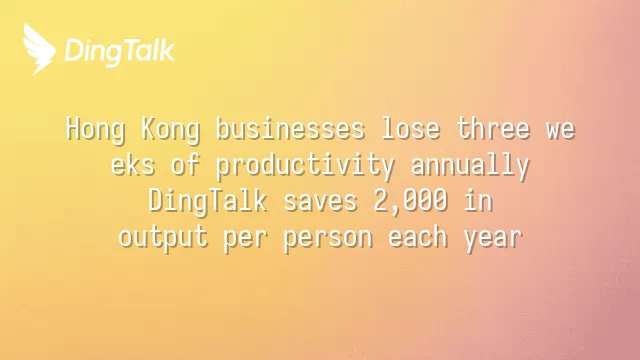
Breaking Hong Kong's Three Structural Bottlenecks in Business Collaboration
Inefficiencies in collaboration among Hong Kong businesses stem not from employee motivation, but from systemic bottlenecks. According to a 2025 HKMA survey, multi-layered approvals, data silos, and communication gaps in remote work have increased project delays by 27%—meaning your team loses nearly three weeks of productivity each year.
System fragmentation means finance, HR, and operations function in isolation, with ERP systems, emails, and instant messaging platforms operating separately, causing decision-making delays. This issue causes interdepartmental compliance reviews to take an average of 72 hours, with 60% of that time spent confirming responsibilities and document status—a visual collaboration toolkit integrates scattered systems so information flows smoothly.
Document version chaos poses another major risk: compliance teams may be working with drafts from three days ago while sales teams act on the latest version, doubling the risk of incorrect decisions. DingTalk’s centralized document management and automatic version tracking ensure everyone stays aligned, reducing legal and operational risks.
Supply chain coordination delays are especially severe in retail: misaligned information between stores, warehouses, and procurement results in only 78% inventory accuracy before promotions, with each error costing over HKD 100,000. A visual collaboration platform provides real-time inventory dashboards, shifting decision-making from reactive to proactive.
- Financial compliance review: Multi-department approval chains take over 72 hours, with 60% of time spent clarifying responsibilities and document status
- Retail supply chain coordination: Information misalignment leads to only 78% inventory accuracy prior to promotional campaigns
- Project management: Decision-makers lack visibility into progress blockers, causing emergency adjustments to be delayed by an average of 1.8 working days
The real turning point lies in transforming "processes" from invisible burdens into visible, manageable, and optimizable assets. When collaboration no longer depends on individual memory or digging through emails, but instead happens via a unified platform with real-time synchronization—where every task’s status, owner, and related documents are clearly visible—efficiency gains become tangible, not just rhetoric.
How DingTalk Smart Office Achieves Full-Process Visualization
DingTalk Smart Office transforms "work progress" from vague awareness into real-time, actionable intelligence.Managers can identify project bottlenecks without meetings, and employees save 30% of their time previously spent compiling progress reports—this is not just a UI upgrade, but a fundamental shift in efficiency models.
Task dashboards make owners and deadlines immediately visible. Since all team members can view updates in real time, repeated inquiries and follow-up emails are minimized, directly reducing communication overhead and enhancing accountability.
Automated workflow diagrams connect cross-functional stages, automatically flagging anomalies in red. Powered by a low-code BPM (Business Process Management) engine, business units can model new processes quickly without IT support. This enables companies to respond swiftly to market changes and deploy new workflows efficiently.
AI-powered progress prediction models provide early warnings of potential delays up to two days in advance by learning from historical project patterns and common bottlenecks. This allows managers to intervene proactively and avoid crises. After implementation at a local accounting firm, form omission rates dropped by 60%, and filing cycles were shortened by 11 days.
This transparency does more than improve efficiency metrics—it rebuilds organizational trust. With synchronized information and clear responsibilities, disputes decrease and response times shift from “waiting for updates” to “proactive intervention.” A 2024 Asia-Pacific knowledge worker survey found that teams using visual collaboration tools reduced decision-making delays by 45%.
The true business value of visualization lies in turning "process health" into quantifiable operational KPIs—error rates, cycle times, and resource idle rates can all be monitored in real time, giving leadership unprecedented insight into process performance.
Dual Breakthroughs in Cross-Departmental Accuracy and Speed
When launching a cross-departmental project still takes five days, companies lose not only time but also market opportunities and client trust. DingTalk Smart Office’s visual collaboration toolkit breaks this deadlock: chat, tasks, schedules, and files are integrated into a single interface, enabling seamless handoffs and consistent collaboration.
Taking TNG Wallet’s internal pilot as an example, the toolkit reduced average project initiation time from five days to just 1.2 days. The key was its support for multilingual real-time collaboration and layered permission controls—when the marketing team drafts a promotion plan, they can instantly share it with IT for technical feasibility assessment. All discussions and revisions are transparent and traceable, dramatically strengthening compliance tracking and accountability.
Context-aware notifications ensure relevant personnel receive critical alerts at the right moment, as the system recognizes task context and priority, preventing information overload or missed deadlines. This feature reduced misunderstandings between departments by 75%.
Smart to-do assignment automatically recommends task owners based on role and workload, using AI analysis of historical patterns and current task loads. This minimizes human errors in delegation and ensures fairer, more efficient task distribution.
Permission controls protect sensitive data by restricting access to authorized members only, meeting both financial-grade security standards and agile operational needs—ideal for Hong Kong’s highly regulated business environment. When workflows shift from “reactive responses” to “proactive execution,” teams unlock hidden labor savings and innovation potential.
A qualitative leap in efficiency ultimately translates into measurable financial gains—the next question is: how do these time savings convert into tangible operational profits and workforce optimization?
From Time Saved to Real ROI in Workforce Cost Optimization
How much profit are you willing to burn annually on repetitive, low-value administrative work? The answer may exceed your expectations. According to a 2024 Asia-Pacific smart office study, after adopting DingTalk Smart Office, companies saved an average of 12.5 administrative hours per employee per month—equivalent to generating an additional HKD 42,000 in annual value per employee (based on Hong Kong’s average hourly wage of HKD 35). This is not an abstract metric, but a strategic resource directly convertible into profit improvement.
Meeting time decreased by 35% because task progress is transparent, eliminating the need for weekly status meetings; email volume dropped by 58% as communication moves into the collaboration platform; urgent correction requests fell by 44% since errors are caught and resolved earlier.
An edtech company case showed that weekly project tracking time dropped from 10 hours to just 3 hours using automated dashboards and @mentions. The saved time was redirected to high-value curriculum development, resulting in seven new course launches within a year and a 19% increase in annual revenue.
This clear cause-and-effect chain—tools drive behavioral change → administrative costs drop → workforce resources undergo strategic transformation—is the core return on digital transformation. True competitive advantage doesn’t come from being “busier,” but from “smarter allocation of effort.”
When your team shifts from firefighting mode to innovation-driven growth, the question is no longer “whether to act,” but “how to deploy efficiently.” Next, we reveal the three critical steps to successful implementation.
Three Key Steps to Successfully Deploy a Visual Collaboration System
The success of implementing DingTalk Smart Office never hinges solely on technology, but on whether a company can bridge the gap between “tools” and “operational DNA.” Over 70% of failed implementations are not due to system failures, but because organizations fail to adjust role definitions and performance metrics in parallel—meaning every dollar invested in digital transformation could vanish due to cultural misalignment.
True transformation requires three critical steps:
- Comprehensively map existing processes: Identify pain points involving redundant communication and information black holes as top digitization priorities
- Clearly define cross-departmental roles and responsibilities: Prevent visual tools from becoming mere “online micromanagement,” and build a foundation of trust
- Adopt a phased rollout strategy: Start with high-frequency, low-risk scenarios such as weekly meeting action tracking or purchase request approvals, allowing teams to build usage habits in a safe environment
Actionable checklist includes:
- Set up real-time KPI dashboards to visualize process efficiency (e.g., average task processing time), helping managers understand actual performance
- Train internal “champion” coaches who lead department-level workshops and scenario-based drills to accelerate adoption
- Establish a weekly feedback loop to continuously refine templates and automation rules, ensuring the system evolves with business needs
A Hong Kong logistics company reduced project tracking time by 40% within six months using DingTalk’s visual dashboards. But the real transformation came from simultaneously adjusting managerial KPIs—from “monitoring attendance” to “driving process momentum.” This isn’t just a software update; it’s a complete reengineering of the company’s digital DNA.
Act now to unlock your team’s hidden capacity: Apply today for a free trial of DingTalk Smart Office and receive dedicated deployment consulting to turn your wasted 42,000 annual hours into growth momentum. Efficiency bottlenecks can no longer hide—just press start.
We dedicated to serving clients with professional DingTalk solutions. If you'd like to learn more about DingTalk platform applications, feel free to contact our online customer service or email at
Using DingTalk: Before & After
Before
- × Team Chaos: Team members are all busy with their own tasks, standards are inconsistent, and the more communication there is, the more chaotic things become, leading to decreased motivation.
- × Info Silos: Important information is scattered across WhatsApp/group chats, emails, Excel spreadsheets, and numerous apps, often resulting in lost, missed, or misdirected messages.
- × Manual Workflow: Tasks are still handled manually: approvals, scheduling, repair requests, store visits, and reports are all slow, hindering frontline responsiveness.
- × Admin Burden: Clocking in, leave requests, overtime, and payroll are handled in different systems or calculated using spreadsheets, leading to time-consuming statistics and errors.
After
- ✓ Unified Platform: By using a unified platform to bring people and tasks together, communication flows smoothly, collaboration improves, and turnover rates are more easily reduced.
- ✓ Official Channel: Information has an "official channel": whoever is entitled to see it can see it, it can be tracked and reviewed, and there's no fear of messages being skipped.
- ✓ Digital Agility: Processes run online: approvals are faster, tasks are clearer, and store/on-site feedback is more timely, directly improving overall efficiency.
- ✓ Automated HR: Clocking in, leave requests, and overtime are automatically summarized, and attendance reports can be exported with one click for easy payroll calculation.
Operate smarter, spend less
Streamline ops, reduce costs, and keep HQ and frontline in sync—all in one platform.
9.5x
Operational efficiency
72%
Cost savings
35%
Faster team syncs
Want to a Free Trial? Please book our Demo meeting with our AI specilist as below link:
https://www.dingtalk-global.com/contact
