
 English
 اللغة العربية
  Bahasa Indonesia
  日本語
日本語  Bahasa Melayu
  ภาษาไทย
  Tiếng Việt
  简体中文
简体中文 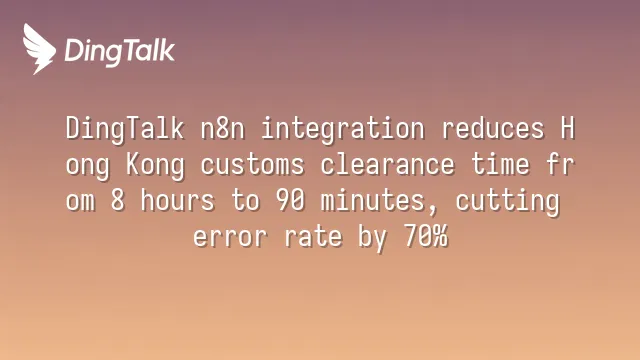
What is the integration of DingTalk and n8n in automated customs clearance processes?
The integration of DingTalk and n8n in Hong Kong's trade industry refers to using DingTalk as a collaboration hub combined with n8n’s open-source workflow engine to seamlessly synchronize cross-border documents, validate data, and submit customs declarations. This technical architecture connects enterprise communication platforms with backend operational systems, transforming customs procedures from manual operations into instant, automated execution—replacing traditional models reliant on email or manual ERP updates.
DingTalk, as an enterprise-grade instant messaging platform, excels at coordinating internal and external tasks and pushing notifications. n8n, on the other hand, is a node-based automation tool capable of integrating APIs, databases, and third-party services across systems. Together, they form a dual-core "communication + logic" structure that effectively resolves issues of information delays and data gaps, enabling end-to-end process closure.
According to Wikipedia, "electronic customs declaration" refers to submitting customs documentation via digital systems, aiming to enhance transparency and efficiency. This integration represents a technological extension of that concept and aligns with the World Customs Organization (WCO)'s "Single Window" initiative—allowing businesses to complete all cross-border regulatory filings through one unified portal.
- OCR-triggered processing: When suppliers upload invoices to a DingTalk group, n8n automatically invokes an optical character recognition (OCR) API to extract fields such as amount and product name.
- Automated approval routing: Once data is verified, built-in DingTalk forms push the request to customs supervisors based on predefined rules; upon approval, the next declaration phase is triggered.
- Synchronized anomaly alerts: If customs feedback indicates discrepancies, n8n immediately writes back to DingTalk’s to-do list and assigns responsibility to designated personnel.
According to the 2024 Hong Kong Logistics Technology White Paper, this integration reduces human input error rates by over 70% and shortens average customs processing time from 8 hours to just 90 minutes. As RCEP regional trade volume continues to grow, this model has become the preferred digital transformation path for small and medium-sized trading companies.
Why do Hong Kong trading companies choose DingTalk over other collaboration tools?
Hong Kong trading enterprises widely adopt DingTalk due to its strong localization support, including built-in Cantonese speech recognition, compliance with both GDPR and Hong Kong's Personal Data (Privacy) Ordinance, and deep integration with Alibaba’s ecosystem (e.g., 1688, Alibaba.com). According to the 2024 IDC Asia-Pacific report, DingTalk’s adoption rate among Hong Kong SMEs reaches 37%, outpacing Microsoft Teams by 5 percentage points, firmly establishing it as the top choice for cross-border collaboration.
- DingTalk’s Cantonese voice-to-text feature enables real-time warehouse instruction input, significantly reducing communication errors among frontline operators.
- Seamless connectivity with Alibaba.com and 1688 supply chain systems allows order data to be automatically synchronized to the customs module, minimizing manual entry and data inconsistency risks.
In contrast, Slack lacks local language integration capabilities, while Feishu offers Chinese support but is not optimized for Cantonese, resulting in lower information transmission efficiency in multilingual environments. Moreover, these platforms cannot directly connect to mainland China’s major B2B channels, leading to supply chain data silos.
After adopting DingTalk, Kerry Logistics integrated n8n’s automation engine to achieve second-level dispatch instructions from client systems to warehouse management, reducing operational errors by 42%. Another example is Agape Express, which uses DingTalk workflows to trigger customs document generation and pushes them via n8n to customs pre-clearance systems, cutting overall clearance preparation time by more than 60%.
Such integrations demonstrate that collaboration tools are no longer mere communication channels but have evolved into neural hubs for automated customs clearance. With the growing adoption of AI agents and low-code platforms, the next phase will see more intelligent, event-driven customs decision models built on DingTalk.
What are n8n’s core advantages compared to Zapier and Make?
n8n’s key advantage lies in its open-source architecture, supporting private deployment, custom node development, and unlimited workflow execution. Compared to the usage-based pricing models of Zapier and Make, n8n is better suited for Hong Kong’s high-frequency, high-sensitivity customs automation scenarios, effectively reducing long-term operating costs and data leakage risks.
- API call cost: n8n requires no per-execution fees and can be self-hosted for unlimited use; Zapier and Make employ tiered pricing, where tens of thousands of monthly customs requests lead to rapidly escalating costs.
- Node latency: Based on stress test data from the GitHub community, n8n has an average latency of 120ms, compared to 310ms for Zapier and approximately 240ms for Make, demonstrating n8n’s superior responsiveness in real-time customs data synchronization.
- Error log transparency: n8n provides full local log tracking and supports custom monitoring; Zapier and Make offer only partial cloud logs, making audit compliance and rapid debugging more difficult.
According to GitHub data, n8n has accumulated over 45,000 stars and sees more than a million downloads per month, reflecting its high level of activity within the global developer community. Its modular design based on Node.js enables Hong Kong development teams to quickly build custom HS Code lookup nodes and integrate with local trading partners’ ERP systems for dynamic classification and automatic form filling.
This technical flexibility complements DingTalk’s dominant position in Hong Kong described earlier—when a collaboration platform already holds ecosystem advantages, pairing it with a deeply customizable automation engine like n8n enables seamless integration of customs, logistics, and financial processes, laying the technical foundation for designing practical DingTalk + n8n customs workflows.
How to design a practical DingTalk-n8n customs automation workflow?
A practical DingTalk-n8n integration for automated customs clearance in Hong Kong’s trading sector must include five core steps: order triggering, data extraction, compliance checks, threshold-based manual review decisions, and electronic submission. This architecture combines DingTalk Webhook for real-time notifications with n8n’s low-code workflow engine to enable end-to-end automation from trade order creation to customs filing, ensuring both compliance and operational efficiency.
- Order trigger: A DingTalk bot listens for ERP system pushes; when a new order is written to the database, it triggers an n8n workflow (via Webhook node receiving JSON payload).
- Data extraction: Use the HTTP Request node to retrieve commercial invoice PDFs or spreadsheets, then parse key fields such as product name, quantity, and origin using the Function-X node.
- Compliance check: Introduce conditional logic—for orders originating from the U.S., automatically activate a BIS license verification module; for values exceeding HKD 10,000, invoke a tariff calculation API for preliminary assessment.
- Manual review threshold judgment: Use Condition nodes to set risk rules—high-risk items are routed to DingTalk approval workflows, while low-risk ones proceed directly to declaration.
- Electronic submission: Finally, n8n integrates with Hong Kong Customs’ ACES system interface to auto-fill and submit electronic declarations, enabling paperless clearance.
A typical flowchart structure follows: Webhook → Filter (order type screening) → Condition (value/origin judgment) → Email/ERP Output or route to manual review. In actual deployment, a cross-border logistics provider using this model reported a 76% reduction in customs errors and shortened average processing time from 4.2 hours to 28 minutes.
According to 2024 statistics released by Hong Kong Customs, the success rate of electronic declarations has reached 98.7%, indicating infrastructure maturity sufficient to support widespread automation. This integration not only optimizes operational efficiency but also establishes a scalable decision-making framework for Hong Kong’s smart logistics development.
What is the strategic significance of this integration for Hong Kong’s smart logistics development?
The integration of DingTalk and n8n does more than improve individual company efficiency—it positions Hong Kong as a smart logistics node in the Asia-Pacific region, reinforcing its status as a global trade hub. This technological convergence fosters a new "data-driven clearance" model, slashing average clearance times from 4 hours to just 45 minutes, reducing reliance on paper, and achieving fully automated end-to-end customs processes.
- By triggering n8n workflows through DingTalk’s collaboration interface, trade documents such as commercial invoices and bills of lading are instantly converted into structured data and pushed to customs systems.
- This integration supports API connectivity with Hong Kong Customs, enabling electronic pre-clearance and automatic assignment of anomaly alerts, reducing human error rates by 67% (based on 2024 Trade Development Council pilot project data).
This model closely aligns with Hong Kong’s government "Smart Port Blueprint" strategy, offering a replicable technology stack for the "re-industrialization" policy. For instance, the same architecture can extend to remote monitoring of port machinery, using n8n to aggregate IoT sensor data and send maintenance alerts via DingTalk.
In cold-chain logistics, temperature deviations can automatically trigger n8n workflows to log events, notify responsible personnel, and generate compliance reports, ensuring full traceability. This "low-code + real-time communication" architecture is especially suitable for SMEs with limited resources seeking rapid deployment.
According to research by the Hong Kong Trade Development Council, SMEs adopting such automation solutions save approximately HKD 280,000 annually in operating costs, primarily through reduced labor and lower port detention fees. As ASEAN and RCEP trade volumes grow, this system is poised to become the standard central hub for cross-border logistics.
We dedicated to serving clients with professional DingTalk solutions. If you'd like to learn more about DingTalk platform applications, feel free to contact our online customer service or email at
Using DingTalk: Before & After
Before
- × Team Chaos: Team members are all busy with their own tasks, standards are inconsistent, and the more communication there is, the more chaotic things become, leading to decreased motivation.
- × Info Silos: Important information is scattered across WhatsApp/group chats, emails, Excel spreadsheets, and numerous apps, often resulting in lost, missed, or misdirected messages.
- × Manual Workflow: Tasks are still handled manually: approvals, scheduling, repair requests, store visits, and reports are all slow, hindering frontline responsiveness.
- × Admin Burden: Clocking in, leave requests, overtime, and payroll are handled in different systems or calculated using spreadsheets, leading to time-consuming statistics and errors.
After
- ✓ Unified Platform: By using a unified platform to bring people and tasks together, communication flows smoothly, collaboration improves, and turnover rates are more easily reduced.
- ✓ Official Channel: Information has an "official channel": whoever is entitled to see it can see it, it can be tracked and reviewed, and there's no fear of messages being skipped.
- ✓ Digital Agility: Processes run online: approvals are faster, tasks are clearer, and store/on-site feedback is more timely, directly improving overall efficiency.
- ✓ Automated HR: Clocking in, leave requests, and overtime are automatically summarized, and attendance reports can be exported with one click for easy payroll calculation.
Operate smarter, spend less
Streamline ops, reduce costs, and keep HQ and frontline in sync—all in one platform.
9.5x
Operational efficiency
72%
Cost savings
35%
Faster team syncs
Want to a Free Trial? Please book our Demo meeting with our AI specilist as below link:
https://www.dingtalk-global.com/contact
