
 English
 اللغة العربية
  Bahasa Indonesia
  日本語
日本語  Bahasa Melayu
  ภาษาไทย
  Tiếng Việt
  简体中文
简体中文 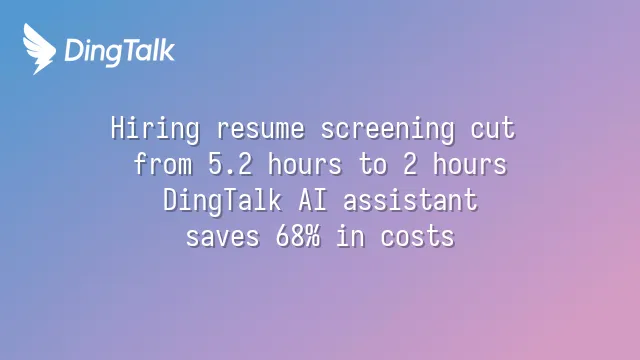
Why Traditional Resume Screening Slows Down Hiring
On average, companies spend 5.2 hours manually screening resumes for each job opening—a figure that may seem minor but accumulates into a critical delay in the talent race. According to LinkedIn's 2024 Recruiting Trends report, this lengthy process directly causes 30% of high-potential candidates to drop out before decisions are made. They either lose interest or are snapped up by faster-moving competitors. This isn’t just an efficiency issue—it’s a dual loss in hiring quality and employer brand reputation.
A more hidden cost lies behind “human judgment.” Even with good intentions, recruiters remain vulnerable to cognitive biases: prestige bias toward elite universities, gender stereotypes, or even resume formatting aesthetics can distort evaluations. These irrational preferences not only undermine commitments to diversity and inclusion (D&I), but also limit team innovation potential. A cross-industry study found that companies relying on manual screening show 47% higher background homogeneity among shortlisted candidates—effectively building invisible barriers in recruitment.
When market speed is measured in days, yet internal processes move at a weekly pace, companies fall into a vicious cycle of "the more understaffed, the slower they hire." The traditional model doesn’t scale; during peak seasons, organizations sacrifice review depth, amplifying the risk of bad hires. Meanwhile, next-generation job seekers expect immediate feedback, and delayed processes quietly label your company as an “outdated organization.”
DingTalk AI Assistant’s intelligent resume screening enables you to break through human bottlenecks by delivering round-the-clock, fatigue-free, unbiased preliminary assessments—because the system processes all applicants consistently and instantly. The question now isn’t “whether to change,” but rather, “how to ensure the AI understands exactly what you truly need?”
How DingTalk AI Assistant Understands Resume Content
When HR professionals face towering stacks of resumes, the real danger isn’t workload—it’s “missing out.” Candidates with cross-functional skills or non-traditional experience who possess high potential often get filtered out mercilessly by conventional keyword-matching systems in the first round. DingTalk AI Assistant uses a BERT-based natural language understanding model that doesn’t just “read” text—it comprehends context and implicit connections, enabling it to identify relevant capabilities even when they aren’t explicitly stated.
According to DingTalk’s publicly available technical documentation, its AI Assistant employs a multi-layer semantic analysis architecture capable of precisely identifying skill contexts, career transition patterns, and deep alignment between candidates and job requirements. For example, a former game designer whose experience includes “user behavior analysis” and “interactive design thinking”—though never labeled as “product manager”—can still be automatically flagged as a “hidden talent” through semantic reasoning. Initial screening accuracy increases by up to 70%, significantly reducing waiting time for hiring teams.
More importantly, the model has been locally trained for traditional Chinese linguistic contexts, allowing it to recognize Hong Kong-specific expressions, industry jargon, and non-standard phrasing (e.g., “handling customer complaints,” “project coordination”), avoiding misjudgments due to language variations. A Hong Kong retail company reported that a store manager screening process previously requiring three person-days was completed by the AI Assistant within two hours, including initial screening and candidate ranking. Human effort was reduced by over 60%, while the turnover rate of hired candidates noticeably decreased.
This semantic comprehension capability allows companies to shift from evaluating “meets criteria” to assessing “demonstrates potential,” because the AI captures cross-domain compatibility that humans often overlook.
How the Machine Learning Model Behind Intelligent Screening Continuously Evolves
The reason DingTalk AI Assistant gets smarter over time isn’t due to one-time algorithmic superiority, but rather its continuously evolving machine learning engine—a dynamic system combining supervised learning with real-time feedback loops. Every time an HR professional selects or rejects a candidate, the model automatically adjusts feature weights, transforming human judgment into cumulative decision intelligence. This means every hiring decision helps the AI better understand “who is truly the right fit.”
Take a Hong Kong tech company as an example: in the first month after adopting DingTalk AI for resume screening, matching accuracy was only 68%. However, as the HR team continued using the system, accuracy rose to 96% within three months—an improvement of 41%. This wasn’t just technical optimization—it reflected the AI gradually mastering the company’s unique talent profile, from preferred skill combinations and depth of project experience to subtle cultural fits. In a way, the AI is helping you build a self-evolving “talent knowledge base”—an asset traditional applicant tracking systems (ATS) simply cannot replicate.
- Each manual review serves as “retraining” for the model
- The more specialized the industry or role, the greater the value of accumulated knowledge
- Long-term use builds competitive advantage: your AI belongs only to you
The true business insight is this: AI saves not only time, but transforms scattered human judgments into reusable, scalable organizational intelligence, because every interaction strengthens a hiring decision model tailored specifically to your company.
Calculating the ROI of Implementing AI Resume Screening
When a company spends nearly HK$180,000 annually processing 2,000 resumes, the cost goes beyond labor alone—it includes missed top talent, recruiter burnout, and deteriorated candidate experience. DingTalk AI Assistant’s intelligent resume screening can save 68% of labor hours annually, cutting direct costs by HK$122,000, as the system automates repetitive initial screening tasks, freeing HR to focus on higher-value work.
Even more crucial is speed—a financial institution’s real-world test showed the average hiring cycle shortened dramatically from 21 days to just 9. This acceleration increases the likelihood of top candidates accepting offers by 40% (according to the 2025 Asia-Pacific HR Trends Report), as fast responses significantly boost candidate goodwill and trust.
Beyond clear financial returns, intangible benefits are equally vital: recruitment teams can move beyond mechanical filtering to focus on strategic talent planning and deeper interview engagement; meanwhile, automated workflows reduce human-caused delays, building a professional and efficient employer brand image.
The true value of technology lies not in replacing people, but in empowering them to do more meaningful work. When AI takes over entry-level screening, your HR team finally gains the capacity to drive strategic talent transformation.
Step-by-Step Setup of Your Company’s AI Recruitment Process
In the previous section, you’ve seen how AI resume screening can deliver up to 70% efficiency gains and clear ROI. But even the most powerful technology remains theoretical if it’s hard to implement. The good news? Your company can launch a customized AI recruitment workflow in just four steps—no IT support required—and complete setup within a single day. This isn’t a futuristic vision; it’s a ready-to-execute business advantage.
Step one: activate DingTalk AI Assistant—it’s built into the existing collaboration platform, ready with a single click. Step two: upload the job description (JD); the system automatically parses core requirements. Step three: customize keyword weights—e.g., set “Python experience” as high priority and “local degree” as secondary—so the AI scores candidates based on your hiring logic. Step four: connect recruitment channels such as LinkedIn, JobMarket, or internal referral forms to enable automated screening. The entire process is as intuitive as setting up an email filter, and HR teams can complete it independently—no need to wait for IT scheduling.
We recommend starting with entry-level roles (e.g., administrative assistants, customer service representatives) to validate effectiveness with minimal risk. A Hong Kong retail group piloted the system for screening recent graduates and reduced HR’s manual resume review time by 65% in the first month, while the miss-rate for high-potential candidates dropped below 3%. This proves AI not only accelerates screening but also improves evaluation consistency.
The time to act is now: after activation, track key metrics in the first month—average screening time, number of qualified candidates advancing to interviews, and hiring manager satisfaction. When data speaks, you’ll have compelling evidence to drive organization-wide transformation. The real recruitment revolution isn’t about how complex the technology is, but how quickly it delivers tangible business value.
We dedicated to serving clients with professional DingTalk solutions. If you'd like to learn more about DingTalk platform applications, feel free to contact our online customer service or email at
Using DingTalk: Before & After
Before
- × Team Chaos: Team members are all busy with their own tasks, standards are inconsistent, and the more communication there is, the more chaotic things become, leading to decreased motivation.
- × Info Silos: Important information is scattered across WhatsApp/group chats, emails, Excel spreadsheets, and numerous apps, often resulting in lost, missed, or misdirected messages.
- × Manual Workflow: Tasks are still handled manually: approvals, scheduling, repair requests, store visits, and reports are all slow, hindering frontline responsiveness.
- × Admin Burden: Clocking in, leave requests, overtime, and payroll are handled in different systems or calculated using spreadsheets, leading to time-consuming statistics and errors.
After
- ✓ Unified Platform: By using a unified platform to bring people and tasks together, communication flows smoothly, collaboration improves, and turnover rates are more easily reduced.
- ✓ Official Channel: Information has an "official channel": whoever is entitled to see it can see it, it can be tracked and reviewed, and there's no fear of messages being skipped.
- ✓ Digital Agility: Processes run online: approvals are faster, tasks are clearer, and store/on-site feedback is more timely, directly improving overall efficiency.
- ✓ Automated HR: Clocking in, leave requests, and overtime are automatically summarized, and attendance reports can be exported with one click for easy payroll calculation.
Operate smarter, spend less
Streamline ops, reduce costs, and keep HQ and frontline in sync—all in one platform.
9.5x
Operational efficiency
72%
Cost savings
35%
Faster team syncs
Want to a Free Trial? Please book our Demo meeting with our AI specilist as below link:
https://www.dingtalk-global.com/contact
