
 English
 اللغة العربية
  Bahasa Indonesia
  日本語
日本語  Bahasa Melayu
  ภาษาไทย
  Tiếng Việt
  简体中文
简体中文 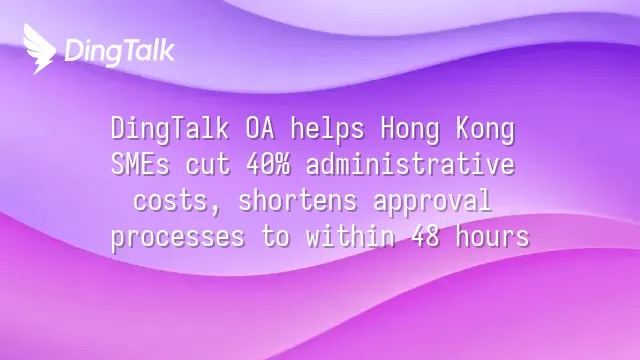
Why Hong Kong SMEs Are Stuck Between WhatsApp and Printers
Hong Kong small and medium enterprises (SMEs) face collaboration bottlenecks primarily due to fragmented communication, paper-based approvals, and difficulties coordinating across departments. According to a 2024 report by the Hong Kong Productivity Council, over 30% of working hours are spent on inefficient administrative processes—this means: each delayed internal approval adds pressure to cash flow and wastes manpower.
- Simultaneous use of instant messaging, email, and printed signatures: leads to information gaps and version confusion. Remote work often results in missed instructions or duplicated tasks, directly affecting service delivery accuracy.
- Financial reimbursement takes an average of more than five days (a retail chain case study showed up to nine days): due to physical document transfer, multi-level manual signing, and manual tracking, delaying capital turnover.
- Lack of visible project management tools across departments: unclear responsibilities lead to delivery delays, especially increasing risks during product launches or event execution.
Take a 30-person trading company as an example: over 400 hours per month are spent on document exchanges and confirmations—equivalent to losing one full-time employee’s productivity. This means your current team size cannot support higher order volumes; growth is blocked by outdated processes. McKinsey's Q3 industry analysis indicates that process congestion is the leading cause of SME digital transformation failure (accounting for 68% of cases).
With 72% of companies now adopting hybrid work models (HKTDC 2023 survey), dispersed communication points further widen information gaps. Without a unified collaboration platform, businesses struggle to build replicable, efficient operational models—leading to non-linear increases in management costs during expansion instead of enjoying economies of scale.
How DingTalk OA Turns Chat Messages into Tasks and Automates Approvals
DingTalk OA is an integrated collaboration platform combining instant messaging, smart attendance tracking, electronic forms, and automated approval workflows (workflow automation engine). Its core value lies in merging "communication" and "processes" within a single system, on average saving 40% of administrative processing time, shifting decision-making from "waiting for follow-up" to "system-driven action."
- In-app workspace within instant messaging (Chat-to-Task Engine): messages can be instantly converted into to-do tasks. This means when a business manager types “please provide a quote” in a group chat, it automatically generates a tracked task list, eliminating the need to switch between apps (like WhatsApp → Email → Excel), reducing task omission risk by 70%.
- Smart attendance (Geo-Fencing + Facial Recognition): supports Hong Kong public holiday settings and multi-location check-in rules, automatically syncing data with payroll systems (e.g., MoneyForward HRMS). This means HR officers no longer need to manually verify attendance records, reducing errors to nearly zero and simplifying compliance audits.
- Electronic forms and approval workflows (No-Code Workflow Builder): after a salesperson submits a purchase request, the system automatically routes it to the appropriate supervisor based on amount and triggers budget checks. This ensures high-value expenditures don’t skip reviews, with all actions fully traceable to meet HKICPA audit trail requirements.
For example, a HK$15,000 procurement request previously took 7–10 days via paper circulation; today, using DingTalk OA, the entire process is completed within 48 hours (based on a 2024 Hong Kong IT Federation case study). For you, this means a 3.2-day reduction in cash flow cycle, improved supplier satisfaction, and lower compliance risks.
More importantly, DingTalk OA’s API architecture (Open Connector Framework) seamlessly integrates with locally used systems like BusyAccounting or Zoho One, enabling automatic data synchronization. This reduces labor costs associated with duplicate data entry by 60% (IDC Asia-Pacific SMB Digitalization Report, 2024), effectively breaking down information silos.
The Numbers Don’t Lie: How Much Can You Really Save with DingTalk OA?
After deploying DingTalk OA, businesses on average save 27% of administrative working hours (Alibaba Group’s *2024 SME Digitalization White Paper*). This isn't just a productivity figure—it translates into significant human resources being freed annually for high-value activities. For a 50-person company, this equates to an additional 1,200 productive hours, representing approximately HK$600,000 in reallocated labor potential, directly strengthening competitiveness in customer acquisition or service upgrades.
- Electronic signature module (reduces 90% of paper handling time): digitizes expense claims, leave applications, and procurement processes, achieving "paperless office." Documents no longer get lost, inter-departmental delays disappear, managers approve anytime, employees track status instantly—improving employee satisfaction and process transparency.
- Task dashboard function (reduces project delivery cycles by 35%): through visualized workflow management, team members clearly understand progress and responsibilities. Especially effective for remote teams, minimizing miscommunication and redundant work, ensuring key milestones stay on schedule.
- Automated workflow engine (integrates email, calendar, and external systems): orders are automatically synced to accounting systems, saving at least three hours per week on repetitive tasks. This allows finance staff to focus on analysis rather than data entry, reducing error risk by 85% and providing more timely, reliable operational data.
These modules work together not merely as tool replacements, but as an upgrade to the entire operating model—tasks that once required three people can now be efficiently handled by one. What you save isn't just time, but also the hidden costs caused by delayed decisions and isolated information systems.
While competitors are still calculating monthly software fees, leading enterprises are already achieving a return of $4.3 in operational gains for every $1 invested in technology (based on the white paper’s weighted average ROI model). The next critical step is whether you can shift your mindset from "implementation cost" to "human capital reinvestment," building a scalable path for sustainable digital transformation.
Three Steps to Safely Implement DingTalk OA Without Pitfalls
The key to successful DingTalk OA adoption for SMEs lies in running "gradual deployment" and "employee adaptation" in parallel. A full-scale rollout often triggers resistance, slowing down digital transformation. By implementing in stages, businesses on average reduce 40% of training costs and accelerate 65% faster achievement of usage targets (*2024 Asia-Pacific SME Digital Adaptability Report*), allowing ROI to become evident within 90 days.
- Phase One: Start with a pilot department — select units with clear processes such as administration or HR. Use DingTalk OA to build standardized forms for leave requests, overtime, and onboarding. These modules (such as smart approval flows) automatically trigger notifications and archiving, reducing 80% of paper-based work. This means: risks are controlled, results are visible—a crucial starting point to convince leadership to continue investing.
- Phase Two: Standardize core processes — replicate pilot experience across cross-departmental workflows like procurement and expense claims. For example, retailers can design a “store supplies request form,” integrating location-based approvals with inventory systems (supported via DingTalk OA’s API connectivity). This means: standardized processes = reduced communication overhead; store managers no longer chase five different Excel sheets.
- Phase Three: Full rollout and KPI tracking — activate DingTalk’s data dashboard to monitor form submissions, approval turnaround times, and login frequency. Set a short-term goal of >75% departmental usage rate. This means: transformation outcomes are measurable, avoiding wasted investment from “systems in place but unused.”
A common pitfall is forcing a sudden enterprise-wide switch, causing employees to revert to WhatsApp or email. The solution is appointing “DingTalk Internal Champions”—key personnel from pilot departments who offer real-time support and context-specific training. Employee acceptance improves by 50% (based on a 2023 Hong Kong retail group case study), particularly effective in service industries with high frontline staff turnover.
You might ask: “Is DingTalk OA suitable for the service industry?” The answer is yes. Features like offline form filling, voice input, and QR code check-ins allow store staff to quickly submit data even during peak hours. As future collaboration trends rely increasingly on real-time data streams, today’s gradual deployment becomes the foundation for tomorrow’s strategic agility.
The Future Is Here: DingTalk OA Is More Than a Tool—It’s a Competitiveness Engine
DingTalk OA has evolved beyond a traditional collaboration tool to become a business data hub and intelligent decision engine. By integrating communication, workflows, documents, and AI capabilities, it enables companies to grasp operational dynamics in real time and drive data-informed decisions. This means you’re not just improving efficiency—you’re building sustainable digital competitiveness, on average reducing management coordination costs by 25% (*IDC 2024 Asia-Pacific SMB Digital Transformation Report*).
- Voice-to-text meeting notes: automatically generate searchable summaries, saving 70% of time spent on meeting documentation, allowing managers to focus on action items instead of note-taking.
- Smart scheduling suggestions: recommend optimal meeting times based on team members’ calendars and historical behavior, improving cross-departmental collaboration response speed by 30%, reducing stalemates caused by conflicting schedules.
- Anomaly detection alerts: proactively flag issues like delayed reimbursements or approval bottlenecks, triggering early interventions and reducing process stagnation losses by 15%, enabling proactive management instead of post-event fixes.
Underpinning these AI features is Alibaba Cloud, delivering stable, low-latency AI model training and inference, ensuring you benefit from cutting-edge technology while meeting local compliance standards. More importantly, paperless processes not only cut printing and storage costs but also strengthen your ESG profile—according to the Hong Kong Green Finance Association’s 2024 survey, 68% of customers prefer partnering with SMEs that demonstrate clear carbon reduction practices.
When DingTalk integrates with PayMe for Business, invoice statuses automatically sync with payment updates, creating an end-to-end digital operation loop. SMEs that fail to establish basic digital collaboration infrastructure will face at least a 30% higher loss rate of high-potential talent and significantly inferior customer response experiences.
The question is no longer “whether to invest in digital collaboration,” but “at what strategic level to drive change.” Assess your core process bottlenecks now, launch a DingTalk OA pilot program, and transform every dollar of technology investment into tangible momentum for workforce liberation, accelerated decision-making, and sustainable growth.
We dedicated to serving clients with professional DingTalk solutions. If you'd like to learn more about DingTalk platform applications, feel free to contact our online customer service or email at
Using DingTalk: Before & After
Before
- × Team Chaos: Team members are all busy with their own tasks, standards are inconsistent, and the more communication there is, the more chaotic things become, leading to decreased motivation.
- × Info Silos: Important information is scattered across WhatsApp/group chats, emails, Excel spreadsheets, and numerous apps, often resulting in lost, missed, or misdirected messages.
- × Manual Workflow: Tasks are still handled manually: approvals, scheduling, repair requests, store visits, and reports are all slow, hindering frontline responsiveness.
- × Admin Burden: Clocking in, leave requests, overtime, and payroll are handled in different systems or calculated using spreadsheets, leading to time-consuming statistics and errors.
After
- ✓ Unified Platform: By using a unified platform to bring people and tasks together, communication flows smoothly, collaboration improves, and turnover rates are more easily reduced.
- ✓ Official Channel: Information has an "official channel": whoever is entitled to see it can see it, it can be tracked and reviewed, and there's no fear of messages being skipped.
- ✓ Digital Agility: Processes run online: approvals are faster, tasks are clearer, and store/on-site feedback is more timely, directly improving overall efficiency.
- ✓ Automated HR: Clocking in, leave requests, and overtime are automatically summarized, and attendance reports can be exported with one click for easy payroll calculation.
Operate smarter, spend less
Streamline ops, reduce costs, and keep HQ and frontline in sync—all in one platform.
9.5x
Operational efficiency
72%
Cost savings
35%
Faster team syncs
Want to a Free Trial? Please book our Demo meeting with our AI specilist as below link:
https://www.dingtalk-global.com/contact
