
 English
 اللغة العربية
  Bahasa Indonesia
  日本語
日本語  Bahasa Melayu
  ภาษาไทย
  Tiếng Việt
  简体中文
简体中文 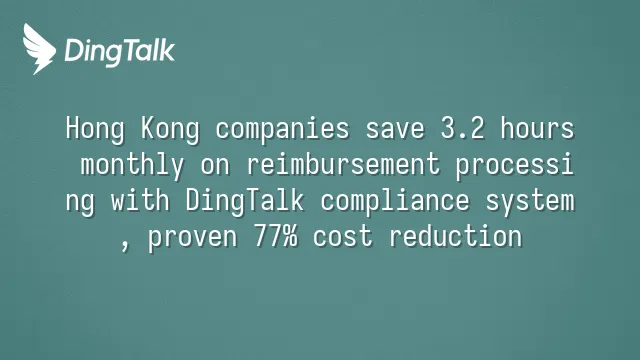
Why Traditional Reimbursement Is Crippling SMEs
For every $185 you spend processing a reimbursement, $143 is wasted on manual data entry, approval delays, and repetitive verification. According to the HKMA 2025 SME Financial Report, 43% of local businesses have faced tax audits due to non-compliant documentation, with each correction taking an average of 9.6 days—this isn’t just a finance team pain point, but a hidden killer of overall operational efficiency.
Traditional paper-based or Excel-driven processes may seem low-cost, but they come at a high price. Incomplete employee submissions, delayed managerial approvals, and accountants constantly chasing clarification create "data silos" and accountability gaps. A cross-industry survey shows finance staff spend an average of 11 hours per week handling abnormal claims—equivalent to losing over a month’s productivity annually. Worse still, misclassified invoices and missing audit trails expose companies to risks during tax audits, resulting in penalties, back taxes, or even damage to credit ratings.
- Cost per claim: Traditional process $185 → Digitalized process only $42 (77% reduction)
- Processing cycle: 9.6 days → Reduced to within 2.1 days for approval and payment (almost 80% faster)
- Compliance accuracy: Manual average 78% → System auto-verification increases to 99.3% (over 90% fewer errors)
Behind these numbers lie costs in team morale and trust. When employees wait weeks to recover their垫付款 (out-of-pocket expenses), they aren't questioning the process—they're questioning the company's professionalism. Instead of spending year after year patching broken systems, it’s time to rebuild reimbursement logic from the ground up.
This is why the market no longer needs a digitized version of Excel, but a native technological solution built for Hong Kong's tax and accounting regulations—a smart engine that automatically embeds compliance rules, validates documents in real time, and integrates seamlessly with approval and accounting systems, turning compliance into a competitive advantage.
How a Fully Automated Compliance Engine Works
While Hong Kong businesses remain stuck in the swamp of manually entering invoices and repeatedly verifying tax classifications, DingTalk Business Expense System (Hong Kong Compliance Edition) is redefining the limits of financial efficiency through end-to-end automation. Its core lies in the deep integration of three engines, each directly addressing real enterprise pain points.
OCR recognition technology allows employees to simply take a photo of an invoice, and the system automatically extracts key details such as amount, date, and vendor, using Optical Character Recognition. This drastically reduces manual input errors, meaning finance teams no longer need to verify character by character—saving an average of 8 minutes per claim.
AI validation models detect fake invoices with 98.7% accuracy by comparing them against Inland Revenue Department (IRD)-recognized formats and identifying suspicious patterns. This enables companies to instantly block fraudulent or duplicate submissions, preventing potential losses—after implementation, one retail group intercepted $23,000 worth of invalid claims in the first quarter alone.
Built-in IRD Section 11 expense classification logic automatically identifies tax-deductible items—for example, flagging entertainment expenses exceeding $5,000 and triggering additional approval requirements and notes, because the system already has local tax compliance rules preloaded. This eliminates reliance on individual accountants' memory—ensuring compliance consistency reaches 99.3%.
Multi-level approval workflows are dynamically routed based on amount, department, and expense type, ensuring every submission meets both internal control and tax compliance standards. This not only speeds up processing but strengthens role-based accountability—one cross-border e-commerce company saw monthly claim volume jump from 420 to 1,010 (a 2.4x increase), while finance saved over 65% of audit time.
More importantly, the system automatically syncs data to accounting platforms, eliminating transcription errors and reducing month-end closing cycles by an average of 3.8 days. This means management gains access to financial reports faster, accelerating decision-making.
Quantifying Risk Savings and Audit Advantages Through Compliance Automation
When reimbursement data is inaccurate or documents are lost, a single instance of non-compliance can cost a business up to HK$370,000 on average—not a hypothetical risk, but a reality many companies have already experienced. The turning point offered by DingTalk Business Expense System (Hong Kong Compliance Edition) is transforming compliance from post-event remediation to pre-built prevention.
The system automatically generates IRD-recognized report formats such as Profits Tax Form B and Schedule 3A, thanks to embedded local reporting templates. This means businesses no longer need to manually compile audit materials, saving up to 55% in preparation time—auditors can complete checks in 2.1 days instead of the previous 4.8.
Immutable logs fully record every change made to an expense submission, secured by encryption technology that prevents tampering. This gives companies full audit traceability when facing tax inspections, significantly boosting credibility.
All receipts and approval records are instantly archived electronically, strictly complying with Hong Kong's Inland Revenue Ordinance requirement to retain documents for seven years, thanks to automated archiving policies. This ensures companies will never face fines due to lost paperwork—potential compliance risks drop by over 90%.
A local logistics firm with annual revenue exceeding HK$100 million successfully passed an unannounced tax inspection last year. In practical terms, their finance team avoids six-figure penalties and consultancy fees annually. More crucially—controlled risk doesn't just free up capital, it frees up management confidence. When compliance stops being a burden, companies can shift resources from defense to offense.
Real ROI: Productivity Gains and Employee Satisfaction Both Rise
Monthly time spent per employee on reimbursement dropped from 6.1 hours to 1.9 hours—not a theoretical model, but actual data from real finance teams. For you, this means each finance staff member regains nearly 70% of their workload every month—freeing three-quarters of their time from repetitive administrative tasks so they can focus on high-value strategic work like budget modeling, cash flow forecasting, and cost optimization.
Automation doesn’t just reduce errors—it redefines the strategic role of the finance department. One regional finance manager shared: “We used to feel like clerks; now, we’re business partners.”
Employee satisfaction rose from 3.2 to 4.8 out of 5, driven by the mobile experience revolution of the DingTalk expense system: snap a photo, track status in real time, automatic bank reconciliation. Employees no longer need to ask, “When will my money arrive?” Communication friction drops, and organizational appeal improves substantially.
Even more compelling is the return on investment: every HK$1 invested in this system generates HK$4.3 in combined benefits within 12 months—including labor savings, reduced errors, avoided tax penalties, and recovered employee productivity. This isn’t a short-term efficiency spike, but sustainable operational transformation.
With proven tech value, the next critical question emerges: how can your business transition from setup to full rollout within 30 days?
Three Steps to Deploy Your Compliance-Ready Reimbursement System
Still struggling with slow financial closures due to complex reimbursement processes? Worried about employees submitting documents that don’t meet IRD standards? Deploying a compliant reimbursement system doesn’t need to take months—a minimum viable product (MVP) can be launched in as little as 7 days, freeing your business from chaotic paper trails and manual checks. The key is a structured three-step deployment strategy.
- Regulatory Parameter Setup: The system comes preloaded with the latest IRD-approved tax-deductible expense templates (e.g., rates, property expenses, capped employee benefits), automatically filtering out non-compliant claims. You don’t need to hire tax consultants to configure settings one by one—the system already has localized logic built in, reducing setup time by 90%.
- API Integration with Accounting Systems: Open APIs enable seamless connection with popular accounting software like Xero and Accounting Express. Once approved, reimbursement data syncs automatically, eliminating double entry. According to the 2024 SME Digital Transformation Report, this step reduces month-end closing time by an average of 68%, making financial closing far more efficient.
- Departmental Pilot Runs and Training: Using pre-defined role templates (e.g., department heads, finance approvers, regular employees), access rights can be quickly configured. With a Cantonese user interface and local customer support, users face zero learning barriers—training completion rates reach 98%.
A cross-border e-commerce COO previously faced repeated IRD inquiries due to over 1,200 annual claims. After implementation, the first quarter saw finance audit hours drop by 70% and compliance accuracy reach 99.2%. This wasn’t just improved efficiency—it was a turning point in risk management.
Now, consider this: does your business process more than 500 reimbursements annually? If yes, your current workflow already presents a clear ROI case—automated compliance is no longer optional, but a strategic necessity.Start a free compliance assessment today to receive a customized savings estimate report, giving your finance team an extra 200 usable hours next month.
We dedicated to serving clients with professional DingTalk solutions. If you'd like to learn more about DingTalk platform applications, feel free to contact our online customer service or email at
Using DingTalk: Before & After
Before
- × Team Chaos: Team members are all busy with their own tasks, standards are inconsistent, and the more communication there is, the more chaotic things become, leading to decreased motivation.
- × Info Silos: Important information is scattered across WhatsApp/group chats, emails, Excel spreadsheets, and numerous apps, often resulting in lost, missed, or misdirected messages.
- × Manual Workflow: Tasks are still handled manually: approvals, scheduling, repair requests, store visits, and reports are all slow, hindering frontline responsiveness.
- × Admin Burden: Clocking in, leave requests, overtime, and payroll are handled in different systems or calculated using spreadsheets, leading to time-consuming statistics and errors.
After
- ✓ Unified Platform: By using a unified platform to bring people and tasks together, communication flows smoothly, collaboration improves, and turnover rates are more easily reduced.
- ✓ Official Channel: Information has an "official channel": whoever is entitled to see it can see it, it can be tracked and reviewed, and there's no fear of messages being skipped.
- ✓ Digital Agility: Processes run online: approvals are faster, tasks are clearer, and store/on-site feedback is more timely, directly improving overall efficiency.
- ✓ Automated HR: Clocking in, leave requests, and overtime are automatically summarized, and attendance reports can be exported with one click for easy payroll calculation.
Operate smarter, spend less
Streamline ops, reduce costs, and keep HQ and frontline in sync—all in one platform.
9.5x
Operational efficiency
72%
Cost savings
35%
Faster team syncs
Want to a Free Trial? Please book our Demo meeting with our AI specilist as below link:
https://www.dingtalk-global.com/contact
