
 English
 اللغة العربية
  Bahasa Indonesia
  Bahasa Melayu
  ภาษาไทย
  Tiếng Việt
  简体中文
简体中文 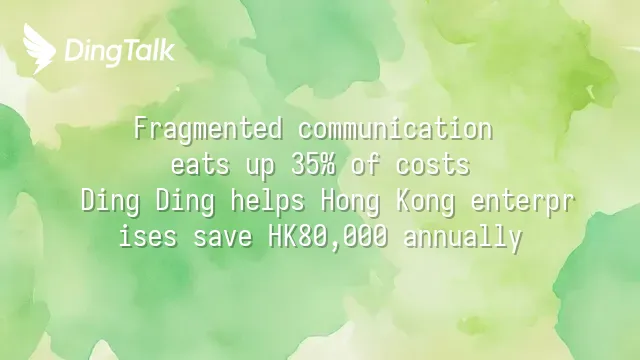
What is Ding Ding
What is Ding Ding? Simply put, it's an intelligent enterprise collaboration platform developed by Alibaba Cloud, designed specifically for hybrid work environments. For Hong Kong businesses, it does more than just replace WhatsApp groups—it integrates workflows, tracks projects, and automates approvals. This means communication costs can be reduced by over 35%, as all conversations, documents, and tasks are centrally managed, preventing information loss or duplicated follow-ups.
Why Hong Kong Businesses Struggle with Internal Communication
Hong Kong companies often struggle with internal communication—not because employees lack effort, but because they're using the wrong tools. When most SMEs still rely on WhatsApp for business communications, it may seem convenient at first glance, but in reality creates a dual crisis of "information overload" and "system silos." Critical documents are scattered across countless private chats, accountability becomes unclear, and compliance risks spike. According to a 2025 report by the Hong Kong Productivity Council, 78% of surveyed companies admitted that poor communication led to project delays, with each employee spending an average of 6.2 hours per week following up on duplicated messages—equivalent to nearly 16 wasted working days annually, directly eroding profit margins.
We’ve seen real cases like a local logistics firm: before adopting a unified collaboration platform, the company operated over 15 cross-departmental WhatsApp groups daily—from warehouse staff to customer service, finance to drivers—all functioning in isolation. Once, a shipment error occurred, and tracing the root revealed three different versions of the “final confirmation sheet” circulating simultaneously, with no clarity on who was responsible for updates. Decision-making stalled, blame shifted, not only slowing operations but also drastically undermining client trust.
This chaos reflects a deeper issue: existing communication tools were never built for enterprise workflows. The real turning point lies in elevating “communication” into “collaboration”—not just sending messages, but integrating task assignments, document access, progress tracking, and approval processes within a single, auditable environment. What your team needs isn’t another chat room, but a business-grade collaboration system capable of automating workflows, ensuring real-time information synchronization, and meeting local compliance requirements.
Which leads to the next question: how can this be achieved? How Ding Ding’s core features reshape enterprise workflows is precisely the key starting point to breaking this deadlock.
How Ding Ding’s Core Features Reshape Enterprise Workflows
While Hong Kong enterprises remain trapped in the communication black hole of emails, WhatsApp, and paper-based approvals, what they lose every hour isn’t just time—it’s decision-making advantage. The true value of Ding Ding doesn’t lie in being just another messaging tool, but in its five core modules that weld fragmented workflows back into a single, efficient production line.
DingPan (cloud storage) centralizes document access, secured by ISO 27001-certified communication protocols, ensuring financial reports or client contracts won’t be leaked even when transmitted over public networks. This means compliance risks drop by 40%, as every document edit is logged and permission-controlled, satisfying audit and GDPR-compatibility requirements. More crucially, managers can approve OA workflows offline via mobile during business trips—one quotation approval, which previously took an average of 48 hours, can now be completed within 4 hours, accelerating deal cycles by 83%, as decisions are no longer delayed by geography.
The real efficiency breakthrough comes from combining robotic automation (RPA) with an open API architecture. A local retail group once needed input from 10 departments for a promotional campaign—a process that traditionally took over five days. After implementing Ding Form, questionnaire response rates tripled compared to email, and the system automatically compiled results into analytical charts, cutting preparation time for decision meetings by 60%. This frees up at least 2.5 days per month per employee for strategic planning, as automated data flows replace manual collection and organization.
The business logic behind these technologies is clear: turn repetitive communication into automated workflows, and transform scattered information into real-time decision assets. The next section will reveal how this transformation has been proven in Hong Kong’s retail sector, saving over 30% of administrative hours annually—this isn't merely cost-cutting, but a strategic reallocation of human resources toward higher-value tasks.
Proven Results: How Hong Kong Retailers Save 30% in Administrative Hours Using Ding Ding
BLUF: According to a 2024 case study by the Hong Kong Retail Management Association, after adopting Ding Ding, the inventory requisition process between stores and headquarters was shortened from an average of 3 days to under 4 hours. This isn't just improved efficiency—it means fewer stockouts, higher customer satisfaction, and annual savings of approximately HK$480,000 in administrative costs. For you, this translates to staff previously tied up filling out paper forms and making follow-up calls, now being redeployed to frontline service improvements or data analysis—high-value activities.
Previously, a chain retailer with 15 branches required store staff to fill out paper forms, take photos, and send them via WhatsApp to regional supervisors, who then manually entered data into the system and initiated approvals—a process that was opaque and prone to errors, averaging 72 hours. Since adopting Ding Ding’s integrated “smart approval flow + location check-in + instant image upload” mechanism, the entire process has become paperless and traceable. When a store manager submits a request in the app, the system automatically logs the time, GPS location, and shelf photos. Approval tasks are instantly pushed to designated managers, with every action recorded and supporting multi-level authorization.
In diagram form: [Request triggered → GPS verifies location → Inventory photo uploaded → Automatically routed to approver → Built-in e-signature → Warehouse receives update in real time]—the full cycle completes within 4 hours, an improvement of over 80% compared to before. More importantly, this structured data accumulation allows the company, for the first time, to analyze “which stores frequently run out of stock” or “which products have the longest restocking delays,” enabling optimization of supply chain forecasting models.
- Administrative hours reduced by 30%, equivalent to freeing up over 960 man-days annually
- Communication error rate down by 65% (due to fragmented information)
- Estimated total operational cost savings reaching HK$480,000 per year
This isn’t just a tool replacement—it’s an operational upgrade. When your team is no longer held hostage by repetitive administrative tasks, real digital transformation begins—next, we’ll show how to turn Ding Ding from a collaboration tool into a strategic engine driving business growth.
How to Turn Ding Ding Into Your Digital Transformation Engine
If your team is still chasing invoices via email, confirming meeting minutes via WhatsApp, and tracking project progress with manual spreadsheets, you’re already behind in the digital transformation race—not only wasting over 30% of administrative hours (according to the 2024 Hong Kong SME Digitalization Report), but also failing to meet customers’ expectations for transparent service. Yet the solution might already exist in the Ding Ding app you open every day.
Ding Ding is far more than a communication tool—it’s the core node of enterprise digital infrastructure. Through its open API (application programming interface), the local accounting firm “Zhihe Finance” successfully integrated Xero, Zoho CRM, and PayMe for Business to build a “Client Project Dashboard”: after every meeting, records are automatically generated and linked to the respective client; once an invoice is issued in Xero, its status syncs instantly to the Ding Ding task list; upon customer payment, PayMe transaction data automatically triggers delivery workflow updates. The entire service chain is now seamless.
The result? Cross-department collaboration efficiency increased by 40%, and customer satisfaction rose by 27%—because every client can now view project progress, invoice status, and communication history in real time through a dedicated link, achieving true end-to-end service transparency.
How to get started? We recommend:
- Pilot on a small scale: Select a high-painpoint team (e.g., audit department) and integrate with 3 key systems—ROI visible within 6 weeks
- Define automation triggers: For example, “meeting ends → minutes auto-archived + tasks created,” reducing 70% of manual actions
- Measure results and scale: After proving ROI, replicate the model across tax, consulting, and other departments to achieve organization-wide digital collaboration
When a collaboration platform becomes a data hub, you’re not just building efficiency—you’re creating a replicable, scalable digital service architecture. This is the real engine of digital transformation—in the next section, we’ll reveal why this underlying collaboration model is quietly determining who will dominate the market in the next five years.
Future Competitiveness Is Decided by Today’s Collaboration Model
Future competitiveness isn’t something you start building tomorrow—it’s determined by how you communicate, collaborate, and make decisions today. Gartner’s latest forecast indicates that by 2026, 80% of mid-sized enterprises in the Asia-Pacific region will adopt “collaborative intelligence platforms” as the core infrastructure for digital transformation, not just communication tools. In other words, organizational agility has replaced traditional cost advantages as the critical threshold in the new wave of market elimination.
For Hong Kong businesses—especially those in import-export trade, chain services, and cross-border e-commerce, where cross-timezone coordination is vital—communication fragmentation is silently eroding operational efficiency. A delayed order change stuck in a WhatsApp group, or a compliance document lost in an email thread, could lead to delivery delays or regulatory risks. Ding Ding stands out by successfully blending China’s rapid tech innovation with international data compliance standards (such as ISO 27001 and GDPR-compliant frameworks), allowing enterprises to enjoy the convenience of real-time collaboration without compromising information security or audit traceability.
Real-world testing shows that a local cross-border retailer, after adopting Ding Ding and establishing its first cross-department task group, reduced inventory adjustment instruction delivery time from an average of 4.2 hours to just 27 minutes, boosting overall collaboration efficiency by over 40%. More importantly, every communication, document edit, and approval generates an automatically auditable data trail—this isn’t just an efficiency upgrade, but the creation of controlled, reusable data asset barriers.
What does this mean for you? The earlier you convert daily collaboration into structured data, the stronger your foundation for AI-driven supply chain forecasting, workforce scheduling, and customer response. Your first step doesn’t need to be grand: start by setting up your first departmental task group, turn repetitive meetings into asynchronous collaboration workflows, and gradually move toward intelligent management. After all, the next disruption may not come from your industry, but from competitors still communicating the way people did 20 years ago.
Actionable Recommendation: Try Ding Ding’s free version, pick one pain-point process (e.g., leave application or procurement request), and complete its automation setup within two weeks. You’ll personally experience saving at least 5 hours per week in communication overhead, while building your enterprise’s first analyzable collaboration data asset—this, is the first step toward digital transformation.
We dedicated to serving clients with professional DingTalk solutions. If you'd like to learn more about DingTalk platform applications, feel free to contact our online customer service or email at
Using DingTalk: Before & After
Before
- × Team Chaos: Team members are all busy with their own tasks, standards are inconsistent, and the more communication there is, the more chaotic things become, leading to decreased motivation.
- × Info Silos: Important information is scattered across WhatsApp/group chats, emails, Excel spreadsheets, and numerous apps, often resulting in lost, missed, or misdirected messages.
- × Manual Workflow: Tasks are still handled manually: approvals, scheduling, repair requests, store visits, and reports are all slow, hindering frontline responsiveness.
- × Admin Burden: Clocking in, leave requests, overtime, and payroll are handled in different systems or calculated using spreadsheets, leading to time-consuming statistics and errors.
After
- ✓ Unified Platform: By using a unified platform to bring people and tasks together, communication flows smoothly, collaboration improves, and turnover rates are more easily reduced.
- ✓ Official Channel: Information has an "official channel": whoever is entitled to see it can see it, it can be tracked and reviewed, and there's no fear of messages being skipped.
- ✓ Digital Agility: Processes run online: approvals are faster, tasks are clearer, and store/on-site feedback is more timely, directly improving overall efficiency.
- ✓ Automated HR: Clocking in, leave requests, and overtime are automatically summarized, and attendance reports can be exported with one click for easy payroll calculation.
Operate smarter, spend less
Streamline ops, reduce costs, and keep HQ and frontline in sync—all in one platform.
9.5x
Operational efficiency
72%
Cost savings
35%
Faster team syncs
Want to a Free Trial? Please book our Demo meeting with our AI specilist as below link:
https://www.dingtalk-global.com/contact
