
 English
 اللغة العربية
  Bahasa Indonesia
  日本語
日本語  Bahasa Melayu
  ภาษาไทย
  Tiếng Việt
  简体中文
简体中文 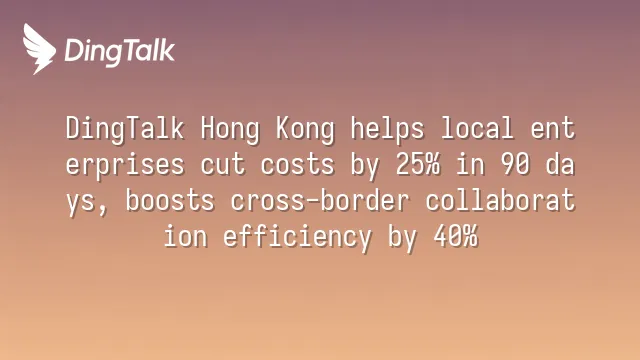
Why Hong Kong Enterprises Are Stuck in Digital Transformation
Digital transformation for Hong Kong businesses is no longer a question of "whether to do it," but rather "running out of time to act." According to the Hong Kong Productivity Council's 2025 report, over 68% of SMEs admit that "digitalization thresholds are too high"—with siloed systems, lack of IT support, and employee resistance to change continuing to slow down efficiency.
Traditional tools like WhatsApp and paper-based approvals cause interdepartmental collaboration to lag by an average of 2.3 days, while remote management often leads to execution gaps due to information asynchrony. These issues stem from a fundamental mismatch between tools and operational needs: multiple software systems cannot integrate, creating data silos; companies hesitate to adopt automation due to programming requirements or high consultancy fees; even when leadership pushes forward, frontline staff resist or comply only superficially due to complex operations.
No-code workflow automation means frontline managers can build processes such as leave applications or procurement using simple drag-and-drop interfaces, deploying changes rapidly without relying on IT departments. This enables companies to complete process transformations in three days that previously took months—such as a logistics manager who built a cargo anomaly alert system, reducing processing time from 8 hours to just 45 minutes, turning transformation from "risk" into "scalable daily improvement."
When tools remain fragmented, the next critical question arises: How can a unified underlying architecture be established so that every automation effort accumulates into the company’s digital assets?
How Intelligent Collaboration Architecture Reshapes Operational Efficiency
DingTalk Hong Kong's integrated solution—"unified PaaS platform + low-code development + AI assistant DingTalk AI"—forms the central nervous system of enterprise operations, resolving traditional system fragmentation. The four-layer integration model (messaging – collaboration – applications – management) connects all communication, approval, and business workflows into an automated network, eliminating information breaks and accelerating both decision-making and execution in sync.
A Hong Kong logistics firm embedded customs documentation, warehouse scheduling, and customs declarations into low-code applications, with DingTalk AI automatically extracting bill of lading details from emails to generate to-do tasks. Results showed a 40% reduction in overall processing time and over 50% decrease in error rates. More importantly, this standardized process can be directly replicated across Southeast Asian branches without re-development or lengthy training, significantly enhancing consistency and resilience in cross-border operations.
According to the 2024 Asia-Pacific Digital Transformation Performance Report, enterprises that achieve process automation complete order cycles 37% faster than peers. This frees human resources from repetitive tasks to focus on higher-value activities like customer service and market expansion, while end-to-end visibility reduces compliance risks and warehousing costs by more than 18%—not just a technology upgrade, but a fundamental restructuring of operational models.
As local efficiency becomes the starting point for global competition, your next question should be: How can data sleeping inside reports actively drive every management decision?
How Data Dashboards and AI Analytics Enable Precision Management
When management still relies on weekly reports and verbal summaries, decisions are already 48 hours behind reality. The built-in data aggregation engine in DingTalk allows managers to instantly monitor project progress, workforce productivity, and resource utilization, transforming passive responses into real-time forecasting through immediate visualization of key metrics.
Alibaba Group’s practices show that combining “smart attendance” with work-hour heat zone analysis reduced idle working hours by an average of 22%; the “OKR tracking dashboard” automatically synchronizes goal achievement rates and roadblocks, improving cross-team alignment efficiency by 40%. Even more groundbreaking is "AI-generated meeting summaries"—the system automatically extracts agenda highlights, action items, and responsible parties, cutting redundant meeting time by 30% and freeing senior executives to focus on strategic advancement instead of information reprocessing.
These management insights, once accessible only to large enterprises, are now achievable for SMEs at extremely low cost through DingTalk’s modular deployment. More importantly, this transparent management is not merely an internal efficiency tool—it is reshaping external trust. Real-time KPI updates and automatic risk alerts mean investors see not just verbal promises, but data-backed performance—this is the first layer of credibility capital for international expansion.
When local operations run as smoothly as steady lines on a dashboard, the next step naturally emerges: How can this level of precision extend into the complex scenarios of cross-border collaboration?
Connecting Cross-Border Business Chains Between Mainland China and Southeast Asia
The biggest challenge for Hong Kong enterprises expanding into Southeast Asia and mainland China lies not in opportunity, but in execution gaps. Language barriers, regulatory conflicts, and system silos are silently eroding collaboration efficiency and profits. A 2024 study found that Hong Kong firms spend an average of 37% of managerial working hours on cross-market communication and data reorganization—slowing down decisions and potentially triggering compliance risks.
Multi-language real-time interface switching allows a Shenzhen warehouse and a Kuala Lumpur sales agent to share the same inventory dashboard, removing language as a barrier to collaboration; deep integration with Alipay and WeChat Work seamlessly connects purchase orders and payment confirmations, reducing manual errors through automated transactions; dual-track compliance framework simultaneously meets GDPR and China’s Personal Information Protection Law (PIPL), ensuring sensitive commercial data remains protected during cross-border flows—without requiring companies to build complex compliance systems themselves.
A Hong Kong beauty brand used this system to achieve real-time inventory synchronization between suppliers in Shenzhen-Dongguan and distributors in Malaysia, shortening promotional coordination time from 3 days to under 2 hours, increasing seasonal sales capture efficiency by over 40%. For you, this means managing diverse jurisdictions through one system—reducing collaboration costs by over 30% while doubling market responsiveness—this is the digital realization of hub advantage.
However, the value of technological integration does not depend on the number of features, but on whether the implementation pace matches business realities. How can enterprises deploy in stages to maximize return on investment while minimizing risk?
Three-Stage Implementation Roadmap and ROI Analysis
DingTalk Hong Kong has helped numerous enterprises validate a clear three-stage implementation roadmap, turning transformation from vague vision into measurable business outcomes.
- Phase One (30 days): Communication Integration and Process Digitization — Unify communication platforms and digitize paper-based approvals to quickly reduce collaboration friction, with expected administrative communication time cut by 40%.
- Phase Two (60 days): Cross-department Automated Workflows — Automatically trigger financial approvals and inventory updates upon procurement requests, reducing human delays, with expected process error rates dropping by 50%.
- Phase Three (90 days): Ecosystem Integration and Data-Driven Decisions — Connect supplier systems and activate sales forecasts for delivery performance tracking, achieving real-time shipment monitoring, with expected project delivery speed increased by 35%.
Based on 2025 performance tracking from partner enterprises, average administrative costs dropped by 25% within six months, and project delivery speed improved by 35%. This matters to you: clear milestones increase predictability of transformation, encouraging sustained leadership investment. After adoption, one logistics executive reported a 40% reduction in cross-regional scheduling meeting time, primarily because automation freed up managerial bandwidth.
This is not just a tool upgrade, but the starting point for enterprises to evolve toward platform-based operations—when internal operations become efficient and transparent, connecting with global partners and markets becomes truly viable. Experience DingTalk Hong Kong today, leveraging China’s advanced digital capabilities to strengthen your local presence and expand globally.
We dedicated to serving clients with professional DingTalk solutions. If you'd like to learn more about DingTalk platform applications, feel free to contact our online customer service or email at
Using DingTalk: Before & After
Before
- × Team Chaos: Team members are all busy with their own tasks, standards are inconsistent, and the more communication there is, the more chaotic things become, leading to decreased motivation.
- × Info Silos: Important information is scattered across WhatsApp/group chats, emails, Excel spreadsheets, and numerous apps, often resulting in lost, missed, or misdirected messages.
- × Manual Workflow: Tasks are still handled manually: approvals, scheduling, repair requests, store visits, and reports are all slow, hindering frontline responsiveness.
- × Admin Burden: Clocking in, leave requests, overtime, and payroll are handled in different systems or calculated using spreadsheets, leading to time-consuming statistics and errors.
After
- ✓ Unified Platform: By using a unified platform to bring people and tasks together, communication flows smoothly, collaboration improves, and turnover rates are more easily reduced.
- ✓ Official Channel: Information has an "official channel": whoever is entitled to see it can see it, it can be tracked and reviewed, and there's no fear of messages being skipped.
- ✓ Digital Agility: Processes run online: approvals are faster, tasks are clearer, and store/on-site feedback is more timely, directly improving overall efficiency.
- ✓ Automated HR: Clocking in, leave requests, and overtime are automatically summarized, and attendance reports can be exported with one click for easy payroll calculation.
Operate smarter, spend less
Streamline ops, reduce costs, and keep HQ and frontline in sync—all in one platform.
9.5x
Operational efficiency
72%
Cost savings
35%
Faster team syncs
Want to a Free Trial? Please book our Demo meeting with our AI specilist as below link:
https://www.dingtalk-global.com/contact
