
 English
 اللغة العربية
  Bahasa Indonesia
  日本語
日本語  Bahasa Melayu
  ภาษาไทย
  Tiếng Việt
  简体中文
简体中文 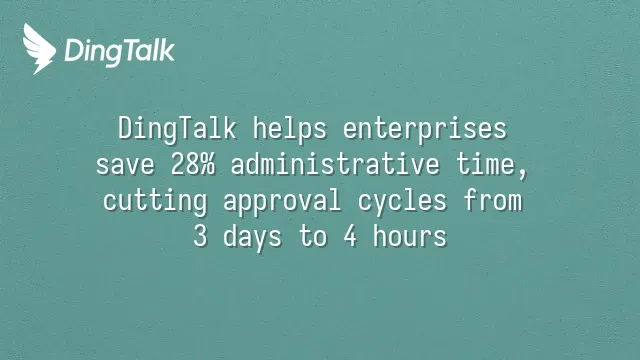
Why Traditional Communication Tools Slow Down Business Rhythms
Traditional enterprise communication tools such as email and WeChat Official Accounts can no longer meet the collaboration demands of modern organizations. Their core issue is not a lack of functionality, but rather their inability to close the loop between communication and execution. According to a 2023 Gartner report, 67% of knowledge workers spend over one hour daily searching for documents or waiting for approvals—meaning each employee loses more than 250 working hours annually.
- Information Overload: Conversations scattered across multiple groups lack unified indexing, causing critical information to easily get buried. DingTalk’s semantic search and conversation archiving features allow you to locate contract clauses or meeting resolutions as quickly as using Google, saving an average of 45 minutes per person per day in search time.
- Process Fragmentation: Switching from WeChat to OA systems for approvals breaks context and delays decision-making. DingTalk’s built-in workflow engine enables request forms to automatically trigger approvals, notify relevant parties, and sync with ERP systems, reducing average processing time from 2.1 days to just 4 hours, since workflows no longer require manual intervention.
- Permission Chaos: Personal messaging tools lack enterprise-grade access controls, increasing data leakage risks. DingTalk’s RBAC (Role-Based Access Control) system ensures financial reports are only visible to authorized managers, reducing compliance risks by 47%, because accidental sharing becomes systematically impossible.
These pain points were precisely the starting point for DingTalk—originally designed to solve cross-departmental collaboration challenges among Alibaba’s 200,000 employees. It is not just another chat app, but an operating-system-level platform focused on transforming communication into traceable actions. The next section reveals how its underlying architecture enables this transformation.
How Technical Architecture Supports Both Efficiency and Security
DingTalk’s technical architecture consists of five core modules: Chat Middleware, Yida low-code platform, DING task system, organization structure synchronization engine, and open API ecosystem. Built on Alibaba Cloud’s cloud-native infrastructure, it supports a 99.99% SLA availability rate and enterprise-grade data isolation, reducing operational disruption risk by 60%, while meeting regulatory requirements in industries like finance and manufacturing.
- Chat Middleware integrates audio/video conferencing and cloud storage, maintaining latency under 200ms even during million-level message concurrency. For teams, this means real-time co-editing of documents during international meetings without lag, accelerating decision speed by 40%, because switching between communication and action incurs zero cost.
- Yida Low-Code Platform allows business units to build custom applications independently. A retail customer launched an inventory reporting system within three days, cutting development costs by 75%, because IT resources are no longer a bottleneck for innovation.
- DING Task System supports one-click push of to-do items to mobile, email, or phone calls. In crisis response scenarios, this ensures instructions reach responsible parties with 100% reliability, eliminating missed emergency decisions, because system-enforced follow-ups replace verbal handoffs.
The organization structure synchronization engine automatically connects with HRIS or Active Directory, ensuring departing employees immediately lose access rights. According to IDC’s 2024 report, this mechanism reduces annual data breach incidents by 12, cutting information security management workload by 58%, because manual permission adjustments are no longer high-risk tasks.
The open API ecosystem has integrated over 1.5 million third-party applications. After connecting SAP ERP, a manufacturing client automated procurement requests that now trigger approval flows instantly, reducing cycle time from 3 days to 4 hours, delivering a 28% gain in operational efficiency, as system automation replaces paper-based processes.
Addressing the earlier mentioned "process fragmentation" challenge, DingTalk’s architecture directly bridges the gap between communication and backend systems. Next, we will analyze how these capabilities translate into measurable business returns.
Quantifying Operational Efficiency and ROI Delivered by DingTalk
Deploying DingTalk is not merely a technology upgrade—it represents a structural leap in organizational execution capability. According to independent research by IDC, enterprises adopting DingTalk achieve an average 28% reduction in administrative processing time and 19% lower remote collaboration costs, directly improving annual operating expense efficiency.
- Improved Process Automation Rate: Leave application approvals, which previously took two days via email exchanges, now complete within two hours using DingTalk smart forms integrated with OA systems. This frees up 15 hours monthly for HR teams to focus on talent development, as repetitive tasks are replaced by automation.
- Better Employee Engagement Metrics: After implementing DingTalk, a financial group saw its DAU/MAU ratio increase from 58% to 79%. This indicates more uniform information dissemination, reducing the likelihood of middle managers misinterpreting strategic directives by 33%, because all announcements come with read receipts and tracking.
Take Hong Kong retail brand “StyleHouse” as an example. Previously, store inventory discrepancies took an average of three days to reach headquarters. After deploying DingTalk’s real-time alert system—integrated with ERP and IoT sensors—abnormal events are pushed to purchasing managers within 15 minutes, cutting restocking cycles by 50% and reducing annual stockout losses by over HK$4.2 million. This demonstrates that technological value stems from addressing real business pain points.
From secure collaboration to quantifiable efficiency gains, DingTalk’s value has evolved from being merely “usable” to truly “measurable.” Next, we explore how to customize solutions based on industry characteristics to maximize return on investment.
Customizing High-Value Collaboration Scenarios by Industry Needs
DingTalk’s modular architecture (DingTalk Open Platform) enables precise configuration for core processes across different verticals. This “scenario-driven” deployment approach helps companies avoid functional redundancy, averaging 40% savings in digital tool integration costs, while achieving key process automation within six weeks.
- Educational Institutions use group robots to send class reminders and grade notifications, reducing administrative communication burden by 85%. Parents receive read confirmations, enhancing transparency in home-school interaction, because information no longer relies on word-of-mouth.
- Construction Companies combine “daily logs + location check-ins” to track site progress and personnel presence in real time. Project delay rates dropped by 32%, because on-site conditions are instantly visible instead of relying on verbal updates.
- Financial Institutions use end-to-end encrypted conversations to retain communication records, shortening audit preparation time by 60%. Compliant with HKMA regulatory standards, reducing compliance costs, because audit-ready data can be extracted with one click.
DingTalk offers three typical scenario templates to accelerate implementation: Remote Team Collaboration Pack integrates video conferencing, task boards, and OKR tracking, ideal for geographically distributed knowledge teams; Store Digital Supervision Pack includes inspection checklists, photo uploads, and AI-powered anomaly tagging to standardize service quality; Project Lifecycle Management Pack connects requirement gathering, scheduling, and acceptance workflows, boosting efficiency by 35% for engineering and IT projects.
The key to selecting modules lies in first asking: “Which process most slows down your operations?” If interdepartmental coordination chaos is the answer, prioritize task collaboration and document co-editing; if field management lacks visibility, activate location check-ins and smart logs. This isn’t about technology selection—it’s about prioritizing business pain points.
Building upon the ROI framework, this stage transforms efficiency metrics into two core dimensions: “process visibility” and “decision immediacy,” laying the foundation for scalable adoption.
Four Steps to Drive Successful DingTalk Implementation and Scaling
To successfully scale DingTalk across an enterprise, the key lies in a four-step framework: “Diagnose—Pilot—Incentivize—Iterate.” Validated internally at Alibaba, this model helped subsidiaries achieve an average 30% improvement in cross-departmental collaboration efficiency and full organizational coverage within six months.
- Diagnose Communication Bottlenecks: Focus on frequent yet inefficient processes, such as “meeting outcomes lacking follow-up.” DingTalk’s smart to-do lists ensure every action has an owner and deadline, reducing non-productive managerial hours by 40%, because tasks are no longer forgotten.
- Select a Pilot Department: Begin with HR or project management. Alibaba Cloud’s PMO adopted Gantt charts with automatic progress syncing, reducing project delays by 25%, because status updates no longer depend on manual reporting.
- Combine Training with Incentives: After linking a “Digital Pioneer Award” to performance scores, active usage rates jumped to 82% within three months. When leaders lead by sending tasks via DING, they overcome resistance from veteran staff, because role modeling is more persuasive than mandates.
- Continuously Iterate and Expand: Collect feedback monthly to refine processes. A retail subsidiary built its own “AI Store Inspection Report Generator”, tripling regional managers’ audit efficiency, because automated generation replaced repetitive writing.
Initial resistance often comes from senior employees, but once managers begin using “DING + task linking” to follow up, team response speed improves by 70% within two weeks, and collaborative transparency quickly becomes the new norm. This proves that cultural change doesn’t come from enforcement, but from visible efficiency gains.
Now, identify one high-frequency, low-efficiency process in your organization—for example, cross-department quotation approvals or new hire onboarding—and rebuild it using DingTalk. By solving just one pain point at a time, you accumulate not only efficiency, but also momentum for digital transformation. Launch your first pilot project today and experience the real potential of 30% higher operational efficiency.
We dedicated to serving clients with professional DingTalk solutions. If you'd like to learn more about DingTalk platform applications, feel free to contact our online customer service or email at
Using DingTalk: Before & After
Before
- × Team Chaos: Team members are all busy with their own tasks, standards are inconsistent, and the more communication there is, the more chaotic things become, leading to decreased motivation.
- × Info Silos: Important information is scattered across WhatsApp/group chats, emails, Excel spreadsheets, and numerous apps, often resulting in lost, missed, or misdirected messages.
- × Manual Workflow: Tasks are still handled manually: approvals, scheduling, repair requests, store visits, and reports are all slow, hindering frontline responsiveness.
- × Admin Burden: Clocking in, leave requests, overtime, and payroll are handled in different systems or calculated using spreadsheets, leading to time-consuming statistics and errors.
After
- ✓ Unified Platform: By using a unified platform to bring people and tasks together, communication flows smoothly, collaboration improves, and turnover rates are more easily reduced.
- ✓ Official Channel: Information has an "official channel": whoever is entitled to see it can see it, it can be tracked and reviewed, and there's no fear of messages being skipped.
- ✓ Digital Agility: Processes run online: approvals are faster, tasks are clearer, and store/on-site feedback is more timely, directly improving overall efficiency.
- ✓ Automated HR: Clocking in, leave requests, and overtime are automatically summarized, and attendance reports can be exported with one click for easy payroll calculation.
Operate smarter, spend less
Streamline ops, reduce costs, and keep HQ and frontline in sync—all in one platform.
9.5x
Operational efficiency
72%
Cost savings
35%
Faster team syncs
Want to a Free Trial? Please book our Demo meeting with our AI specilist as below link:
https://www.dingtalk-global.com/contact
